Archlog
Michael Young and Mira Almazrooei in Conversation with Laura Sparks
POSTED ON: February 8, 2018
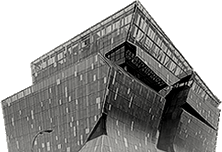
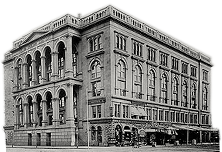
Professor Michael Young, student Mira Almazrooei and alumnus Daniel Wills examine the Foundation Building’s iconic elevator shaft through collage and drawing.
Tags: Michael Young, Laura Sparks
Ben Aranda's Window to the Heart Installed in Times Square
POSTED ON: January 31, 2018
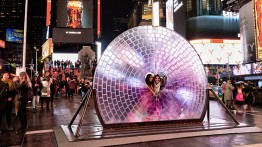
Window to the Heart - Photo Courtesy Formlabs

Window to the Heart - Photo Courtesy Formlabs

Window to the Heart - Photo Courtesy Formlabs
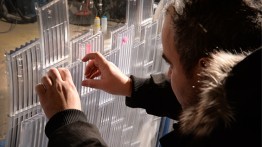
Window to the Heart - Photo Courtesy Formlabs
Professor Benjamin Aranda’s firm, Aranda/Lasch has designed a new architectural installation in the heart of Times Square. Built in collaboration with Marcelo Coelho and sponsored by the Design Trust for Public Space and Times Square Arts, the project, titled “Window to the Heart” is on view from February 1st, 2018 – February 28th, 2018. Located at Father Duffy Square, between 46th and 47th streets, the installation consists of a 12-foot diameter Fresnel lens with a heart-shaped window in its center.
Rather than using the traditional lens-making methods of casting, cutting, and repeatedly polishing glass, Window to the Heart will leverage the latest advances in design, materials, and fabrication to craft something that was previously unattainable. Each of the almost 1,000 lens segments is 3D-printed at a high resolution by Formlabs using clear resin, a material capable of the unique surface quality and clarity required by optical elements. With the lens made entirely from a 3D-printed material instead of glass, Window to the Heart upends the centuries-old methods of lens-making to invite individuals to reimagine how they see and photograph the world.
AIANY Releases Statement on the US Exit from Paris Climate Accord
POSTED ON: June 7, 2017
On June 5, AIANY President David Piscuskas released a statement strongly condemning the U.S. withdrawal from the Paris Climate Accord. This latest dispatch stands in stark contrast with a much-criticized statement released after the last election, in which AIA President Robert Ivy seemed to offer an olive branch of sorts to the incoming Trump Administration.
Piscuskas articulates an oppositional stance to that of the current Administration with regard to environmental regulations; “AIANY has long been devoted to fostering a more sustainable and resilient built environment and we hereby reaffirm our ongoing commitment to the mitigation of climate change. We will continue to help architects and other design and construction professionals gain the skills and knowledge to design better, more energy-efficient buildings; advocate for policies that promote sustainability in both the built and natural environments; and raise public awareness about the role of buildings in combating climate change.”
Nader Tehrani Lecture | Current Work: Schools of Thought
POSTED ON: May 30, 2017
In addition to his role as Dean of The Irwin S. Chanin School of Architecture, Nader Tehrani is the principal of NADAAA, a practice he founded in 2011 with Katherine Faulkner and Daniel Gallagher. The firm grew out of Office dA, a practice he formed in 1986 with Rodolphe El Khoury, which later expanded to include Monica Ponce de Leon in 1991. With offices in New York and Boston, NADAAA is dedicated to “the advancement of design innovation, interdisciplinary collaboration, and an intensive dialogue with the construction industry.”
He organizes his lecture around three projects for schools of design: the Hinman Research Building at the Georgia Institute of Technology, the Melbourne School of Design at the University of Melbourne, and the Daniels Faculty of Architecture, Landscape and Design at the University of Toronto. These projects explore the relationship of these buildings to spaces of scholarship, making, and the accidents that happen in between these moments and, “some kind of reciprocity between the institutions we [as architects] try to cultivate, and the spaces they foster.”
The lecture is followed by a discussion with Florian Idenburg, a founding partner of SO–IL and Associate Professor in Practice of Architecture at the Harvard Graduate School of Design.
This lecture took place in the Great Hall of The Cooper Union on April 5, 2017.
Tags: Nader Tehrani