Full-Time Faculty
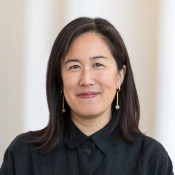
Irene Cheng is an associate professor in Architecture at the Cooper Union. An architectural historian and critic, her research explores the entanglements of architecture, culture, environment, and politics in the nineteenth and early twentieth centuries. Cheng is author of The Shape of Utopia: The Architecture of Radical Reform in Nineteenth-Century America, and co-editor of Race and Modern Architecture: A Critical History from the Enlightenment to the Present (with Charles L. Davis II and Mabel O. Wilson) and The State of Architecture at the Beginning of the 21st Century (with Bernard Tschumi). Her book The Shape of Utopia received the On the Brinck Award in 2024. She is currently working on a book that explores the political ecology of Arts and Crafts architecture, as well as a related collaborative project called the Materialities of Empire.
Cheng received a B.A. in Social Studies from Harvard University, and M.Arch and Ph.D degrees from Columbia University. She previously taught at Columbia University, UCLA, and the California College of the Arts, where she served as chair of the Graduate Architecture program and as a founding co-director of History Theory Experiments, a platform for advanced interdisciplinary research and critical engagement in architecture.
Cheng is the recipient of a Diversity Achievement Award from the Association of Collegiate Schools of Architecture and an AIA SF Community Alliance Award. Her work has been supported by fellowships from the Graham Foundation, Whiting Foundation, McNeil Center for Early American Studies, MacDowell Colony, and National Endowment for the Humanities.
Previously Cheng worked as an architectural designer for Bernard Tschumi Architects before launching her own firm, Cheng + Snyder, with Brett Snyder. Cheng + Snyder’s project Museum of the Phantom City was exhibited at the Venice and Chicago biennials. The firm’s work has been published in Metropolis, Architectural Record, The Architect’s Newspaper, The New York Times, and in numerous books and blogs.
Cheng's CV is available here.
Doug Ashford A'81 is an artist and has taught at Cooper Union since 1989. He is also a visiting Associate Professor for the MFA Program in Painting at The Yale School of Art. Ashford’s principal art practice from 1983 until 1996 was Group Material, a collaborative project that used exhibition design and social practice in museums and other public spaces to imagine new political forms. Prominent in this history are the exhibitions: The Castle (dOCUMENTA 8, Kassel, Germany, 1987), Democracy (The Dia Art Foundation, New York, 1988) and AIDS Timeline (The Berkeley Art Museum 1989, Wadsworth Atheneum, 1990, The Whitney Museum, 1991). Group Material’s work in exhibition production, public cultural display, and the mobilization of politics continue to affect many disciplines in and around the production of contemporary art. The sixteen-year history of the group is documented in the book Show and Tell: A Chronicle of Group Material, (Julie Ault, ed. Four Corners Books, 2010). After 1996, Ashford went on to make paintings, produce exhibitions and publish articles independently and in other collaborations. Who Cares (Creative Time, 2006), is a book project built from a series of conversations between Ashford and an assembly of other cultural practitioners on public expression, beauty, and ethics. His painting installations have been shown recently at dOCUMENTA 13, Kassel (2012), The Henie Onstad Center, Norway (2013) and the 11th Gwangju Biennale (2016). Ashford’s book, Writings and Conversations, (Mousse Publishing, 2013), was published on the occasion of a retrospective exhibition of his work at the Grazer Kunstverein, (AU). His work is represented by Wilfried Lentz Rotterdam.
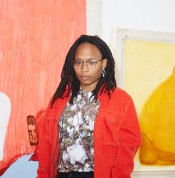
Jennifer Packer received her BFA from the Tyler School of Art in 2007 and her MFA from Yale University in 2012. She was a 2012-2013 Artist-in-Residence at the Studio Museum in Harlem and a Visual Arts Fellow at the Fine Arts Work Center in Provincetown, MA, from 2014- 2016. Her work was most recently featured in two major solo exhibitions: The Eye Is Not Satisfied With Seeing, a 10-year survey at the Serpentine Galleries in London and Whitney Museum of American Art, and Every Shut Eye Ain’t Sleep at LA MOCA. Her first solo institutional exhibition, Tenderheaded, was shown at the Renaissance Society in Chicago in 2017 and at the Rose Museum at Brandeis University. Her work was included in the 2019 Whitney Biennial and P.5 - Prospect New Orleans (2021).

Professor Melody Baglione received a Ph.D. and M.S.M.E. at the University of Michigan in Ann Arbor and a B.S.M.E. at Michigan Technological University in Houghton, Michigan. She received the National Science Foundation (NSF) Graduate Research Fellowship and brings with her 7+ years of industry experience (primarily in automotive powertrain systems but also management consulting). Professor Baglione is currently developing inductive and hands-on teaching methods by integrating case studies, practical laboratories, and real-world projects into the mechanical engineering curriculum. Her current projects include: a NSF-funded project to incorporate sustainability into the control systems curriculum by creating learning opportunities related to our Building Management System and heating, ventilation, and air-conditioning systems; designing interactive technologies that promote science, technology, math, and engineering to young children and those with special needs; developing vehicle system models and algorithms for optimizing powertrain configurations and control strategies; and characterizing structural dynamics properties using experimental modal analysis. Professor Baglione teaches Systems Engineering (ESC161), Feedback Control Systems (ME151), Engineering Mechanics (ESC100), Mechanical Vibrations (ME101), Advanced Mechanical Vibrations (ME401), and Acoustics, Vibration, and Noise Control (EID160).