Full-Time Faculty
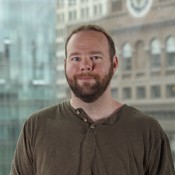
Sam Keene is a professor of computer science at The Cooper Union. He received his Ph.D. in electrical engineering from Boston University, where his research has focused on cross-layer techniques to resolve collisions in wireless random-access networks. He also received an interdisciplinary certificate in computational science, He currently teach a wide rangeof classes at The Cooper Union, ranging from intro coding to graduate level machine learning. His research is broadly focused around signal processing and machine learning, with applications mostly in healthcare and environmental monitoring, He also has several interdisciplinary collaborations with the schools of Architecture and Art, with a focus on teaching students how work collaboratively to make cool stuff. Some classes focus on interactive work using AI and machine learning for creative applications, others are focused on working with non-profits on data visualization and analysis. He also runs a secret brewery in one of the labs.
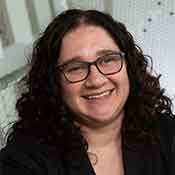
Dr. Michelle Rosen earned her Ph.D. in Engineering Sciences/Mechanical Engineering from Harvard University, where her research focused on the design and fabrication of biologically inspired robotics. She developed the RoboMoth, an insect-scale flapping wing robot that is control- and power-autonomous. She was a recipient of the National Science Foundation Graduate Research Fellowship and also served as the outreach coordinator for the Microrobotics Lab. Her current research interests are in the mechanical design, fabrication, and integration of robotics at representative scales with bio-inspired morphologies.
Since graduation, Dr. Rosen has been lecturing at Harvard, teaching the introductory and capstone engineering courses. She is passionate about active learning and hands-on projects in the engineering classroom. She has also advised many senior theses and served as a first-year academic adviser.
Prior to arriving at Harvard, Dr. Rosen completed her B.S. in mechanical engineering at the University of Maryland, College Park, where she participated in research in microrobotics and computer vision. In her spare time, Dr. Rosen likes to experiment in the kitchen, play video and board games, and play flute and piccolo.
“I am so delighted to join The Cooper Union family! I am continually impressed with the strong emphasis the school has placed on inclusive and diverse education and I’m excited to contribute to this mission, especially in elevating women and minorities in STEM. I’m ready to get my hands dirty while building things in the classroom and the lab with some amazing Cooper students. I look forward to meeting all the students and my colleagues in person and helping create the next generation of extraordinary roboticists, researchers, and engineers!”
Dr. Topper is an expert in physical, computational, and theoretical chemistry who is known for his contributions to the theory of nonlinear dynamics and the development of innovative Monte Carlo methods for high-performance computing and analysis. Current research in his laboratory includes the study of acid-base nanoparticles using first-principles quantum mechanics, and the use of machine learning-aided molecular dynamics simulations to characterize and predict large-scale structural transitions in materials and biomolecules.
He received a B.S. in Physics and Chemistry from Florida State University and earned a Ph.D. from Yale University. He then worked for two years as a postdoctoral researcher at the University of Minnesota and one year at the University of Rhode Island before joining the Cooper Union in 1993. Dr. Topper has also chaired the Department of Chemistry and Physics at Monmouth University.
To date, Topper ‘s research projects have included mentoring over 115 undergraduate, graduate, and high school students as research colleagues and co-authors. His work is highly collaborative and interdisciplinary and has been presented at numerous national and international scientific conferences. Prof. Topper’s papers and review articles have been published in some of the most selective journals in the field, including Physical Review Letters, the Journal of Chemical Physics, the Journal of Physical Chemistry A&B, Reviews in Computational Chemistry, and Advances in Chemical Physics. Together with his students and colleagues he has published 62 peer-reviewed manuscripts, learning objects, and conference abstracts; written / co-authored 4 book chapters and 4 book reviews; organized 5 international scientific conferences; and given 23 invited seminars at colleges, universities, conferences, and high schools.
Topper loves teaching a variety of courses, including lecture and laboratory courses at the freshman, junior, senior, and graduate levels in general, physical, theoretical, and inorganic chemistry as well as courses in research and engineering design projects. He is an avid amateur musician and songwriter who enjoys performing for friends and family as well as at fundraisers and community festivals. Other interests include volunteer work at the local community food pantry and the New Jersey State Youth Orchestra, which he serves as a member of its advisory board. He also enjoys graphic novels, animation, games of all kinds, and hiking and traveling with family.
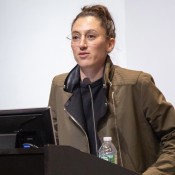
Nora Akawi is a Palestinian architect, and an assistant professor at The Cooper Union, New York. She focuses on erasure and bordering in settler colonialism and works at the intersection of architecture with border studies, cartography, and archive theory. Prior to joining The Cooper Union, Nora taught at Columbia University’s GSAPP, where she was the director of Studio-X Amman since 2012, and the founding director of the Janet Abu-Lughod Library and Seminar since 2015. She curated Al Majhoola Min Al-Ard (this earth’s unknown) at the Biennale d’Architecture d’Orléans (2019), and co-curated Sarāb: Wadi Rum, a festival of experimental electronic music and performance from the Arab worlds (2019), and Friday Sermon at the Biennale Architettura in Venice (2018). She co-edited the books Friday Sermon (2018) and Architecture and Representation: The Arab City (2016). Together with Eduardo Rega Calvo, in 2019 she co-founded the interdisciplinary research and design studio Interim Projects.
Professor Akawi is on sabbatical for the 2025-26 academic year.