Full-Time Faculty

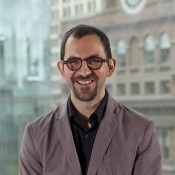
Abhishek Kumar Sharma is an Assistant Professor at the Albert Nerken School of Engineering at The Cooper Union for the Advancement of Science and Art. He leads the interdisciplinary scholarship at the META lab. He is in the process of developing a modern take on the classic chemical engineering transport sequence. He is also developing original electives on phase transitions, molecular simulations, and various interdisciplinary themes spanning science, art, and humanities.
Abhishek received his undergraduate degree in chemical engineering from IIT Delhi in 2016 followed by a PhD in the same subject from Cornell University in 2021. For his graduate work, he received the 2020 Austin Hooey Award for Graduate Research Excellence. Before Cooper, he worked as a postdoctoral scholar at The University of Chicago's molecular engineering department.
Abhishek's research interests have varied over the years, having published peer-reviewed articles in the fields of biopharmaceuticals, molecular simulations, and metamaterials.
Abhishek has also devoted efforts to public and artistic expositions of science, having developed original science demonstrations, science podcasts, and theater at the intersection of science and art. In recent years he has found himself inclined to make art using technology as a medium, creating simulation renderings, photography, and video. His work won the 2022 FOMMS Movie Award,
In his free time, Abhishek enjoys hyperfixating on song lyrics, writing poetry, meditating over slow-cooking, collecting all sorts of patterns in clothing, and taking long aimless walks.
Dr. Eric Lima received his doctorate in Biomedical Engineering in 2008 from Columbia University. His research focused on the regeneration of cartilage and bone using living cells. He built custom-designed bioreactors for orthopedic applications. At Cooper Union he continues his tissue engineering research while bringing hands-on teaching and design expertise to the classroom. Dr. Lima teaches basic design classes that utilize milling machines, welders, lathes, and other large equipment. Students then combine these mechanical instruments with electrical components and computer programs to prototype their ideas. He is active in the open-source hardware community and is building a library of open-source designs for equipment used in a laboratory.
Dr. Cosmas Tzavelis is a Professor and George Fox Chair of Civil Engineering at The Cooper Union. He has been teaching the Structural Analysis and Design classes such as Introduction to Engineering Design, Structural Analysis I and II, Solid Mechanics, Steel and Concrete Design, Experimental Projects and Senior Design projects. He is the Faculty Advisor of the student ASCE club and has been recognized by the Cooper Union students for his passion and dedication towards their education.
Prof. Tzavelis has obtained his Ph.D. in Civil Engineering and Engineering Mechanics from Columbia University with his dissertation entitled "Seismic Reliability of Rigid Frame Structures”. His research interests include Information Management in Architecture, Engineering and Construction (BIM etc), Innovative Bridge Design and learning from Nature as well as Structural Analysis of the human skeleton and joints.
Prof. Tzavelis is a registered Professional Engineer in the state of New York and consults local firms in Building Information Management and Structural Steel design. In the past he was involved in the Rehabilitation of the bottom lateral system of the Queensboro Bridge in NY, the issue of guidelines for the Inspection, Evaluation and Repair of the Bridges of New York City, and the Design of the Day Center and Student Housing of the University of West Indies in Trinidad.
He has been elected to the Who’s Who Among American Teachers publication, nominated by the National Dean’s List students, honoring those special teachers who “took time to lead, inspire and demand excellence”. He was Honorablly mentioned and received an award for the design of the Bridge of the Future, at the Great Seto Bridge Memorial Center in Japan and received a Prize from the American Aluminum Association for the design of a prefabricated aluminum partitioning system.
Selected publications and Master’s thesis supervised include: "An object-oriented xml database to share engineering data" , “Giving Meaning to Design Data Using XML” , “A Structural Engineer’s guide to using Revit Structures”, "Effects of pre-stressing on the Structural Behavior of Stress-Ribbon Bridges”, “A new approach in structural analysis using 3-d moment distribution and visual basic” , "An object oriented database management system for sharing engineering data", "An object-oriented approach to establish relationships between civil engineering building objects".