Full-Time Faculty
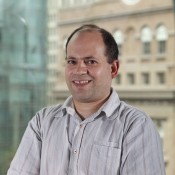
Prof. Carl Sable joined the Cooper Union faculty in 2003, and is currently a full faculty professor in the Department of Electrical Engineering. He teaches required courses in the Computer Engineering track of EE, including Data Structures and Algorithms I and II, and regularly advises Senior Projects. He also commonly teaches Masters level electives that include Artificial Intelligence, Natural Language Processing, and Computer Graphics. Other courses he has taught in the past include Software Engineering, Databases, Digital Logic Design, Advanced Computer Architecture, and Compiler Theory.
At Cooper Union, Prof. Sable has advised over 35 Master students who have completed their degrees; the topics of their thesis have ranged the gamut of EE, but the majority have focused on subtopics of Artificial Intelligence, Machine Learning, and Natural Language Processing. In addition to research through Master students, he was one of the Principle Investigators of a funded research project involving a collaboration with MaXentric Technologies. The project was funded as an STTR, and was funded through Phase II. The task involved the use of software defined radios, provided by Rockwell Collins, to create a Cognitive Communications Gateway Engine capable of translating signals between waveforms. He also voluntarily serves as the Engineering Faculty Secretary, and annually coach teams of students entering the ACM Greater New York Regional Collegiate Programming Contest.
Before coming to Cooper Union, Prof. Sable was a graduate student at Columbia University, receiving his Master's degree in Computer Science in 1999 and Ph.D. in Computer Science in 2003. As a graduate student, he was part of the Natural Language Processing research group, advised by Prof. Kathleen McKeown. His research focused on the use of text categorization techniques to classify associated images. Before graduate school, from 1993 through 1997, he worked as a Software Design Engineer at Microsoft. As part of the Excel group, he helped develop versions of Excel ranging from Excel 5 through Excel 97. Before that, he received his B.S.E. in Electrical Engineering from Princeton University in 1993.
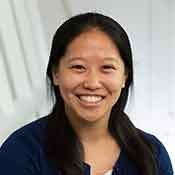
Dr. Cynthia Lee, received her Ph.D. in Civil Engineering from the Georgia Institute of Technology, where her research focused on probabilistic methods for improving critical infrastructure resilience. Specifically, she developed frameworks to increase infrastructure monitoring capabilities with nontraditional data sources through data integration and machine learning classifiers and investigated the impact of network parameters on component vulnerabilities.
During her Ph.D., Dr. Lee received the first-place paper award in infrastructure at Resilience Week 2018, completed Georgia Tech’s Tech to Teaching certification through the Center for Teaching and Learning, and received nominations to participate in several workshops for promoting diversity and interdisciplinary collaboration in research and academia.
Prior to her Ph.D. work, she received her bachelor’s and master’s degrees in Civil Engineering from Tufts University and Stanford University, respectively. In her spare time, Dr. Lee enjoys rock climbing, hiking, and exploring new cities through eating.
“I am so excited to join the engineering faculty at the Cooper Union! My research interests are in improving infrastructure resilience, especially in urban environments, and New York City is full of opportunities to explore the impacts of civil infrastructures on our daily lives.
I am also passionate about teaching and building up students’ confidence in their own abilities, and I am excited to work with the students at Cooper. I had the pleasure of meeting students during my visit, and seeing their enthusiasm, engagement, and curiosity was one of the most important factors in my decision to join the Department of Civil Engineering at Cooper. I am looking forward to being on campus and meeting the students and faculty in person someday soon!” – Cynthia Lee

Ninad Pandit, Assistant Professor of History, is an architect, urban planner and a historian of modern South Asia. He is also an Affiliated Faculty in the Cooper Union’s School of Architecture. His scholarship examines the relationships between urbanization, industrialization and the emergence of radical politics in colonial India.
Currently, Ninad is working on The Bombay Radicals, a book project that tells the story of the origins of the working-class movement and the Left in colonial western India and argues that the process of translating ideas of communism and mass mobilization for use in colonial contexts produced new knowledge about organizing workers and developed new strategies for unionizing, striking, and providing strike relief. It also argues that this knowledge was critical in developing a new kind of mass politics in colonial India, one that shaped popular mobilizations led by M. K. Gandhi in the 1930s and 1940s. Finally, the book shows how the rise of Gandhi’s nationalist urban mass mobilizations led to a decline in the popular support for the Left, ultimately paving the way for a new, right-wing, xenophobic political campaign.
At the Cooper Union, Ninad teaches courses on the history of the modern world in the HSS Core Curriculum and electives on urban histories and migration in the global south. He also teaches in the School of Architecture’s History Core and occasionally offers Architecture electives.
Ninad received his PhD from the Department of History at Princeton University. He also holds professional degrees in City Planning/Design from the Massachusetts Institute of Technology and in Architecture from the University of Mumbai. He was previously the Singh Postdoctoral Fellow at Yale University, and a Mellon Fellow in Cities and the Humanities at LSE Cities, London School of Economics and Political Science.