Eladio Dieste: Material Tour de Force
Thu, Nov 13, 12pm - Sun, Nov 30, 2025 6pm
Add to Calendar
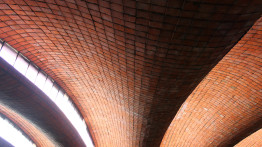
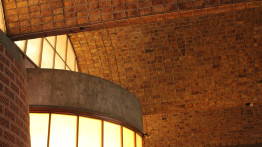
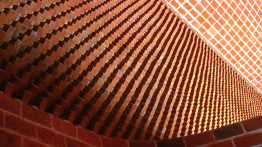
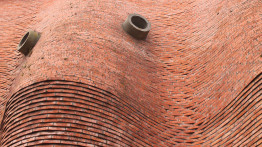
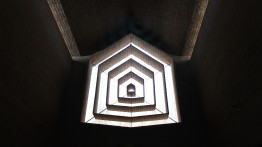
In the fall of 2012 Julián Palacio traveled to Uruguay to visit the work of the engineer Eladio Dieste as part of The Deborah J. Norden Travel Fellowship awarded by The Architectural League of New York. This research was motivated by a desire to explore historical precedents that challenge our traditional understanding of the production of architectural form, and that have put forward alternative arguments about the ways in which the performative qualities of certain building systems—such as structure in the case of Dieste—can be used to potentialize possibilities for material invention. These ideas are extremely relevant today: accelerated developments in design and fabrication technologies are fostering an expanded field of formal investigations that need to be brought into tactical alignment with other disciplinary logics to demonstrate their true transformative capacity.
Eladio Dieste emerged as one of the most paradigmatic figures in the diverse landscape of mid-20th century Latin American architecture. Born in 1917 in the northern town of Artigas, Uruguay, he studied at the University of the Republic in Montevideo, graduating from the Faculty of Engineering in 1943. Soon after, he established his independent engineering and construction company, Dieste & Montañez S.A., and embarked on a professional career spanning five decades. His practice focused on designing buildings for everyday use: churches, bus terminals, warehouses, and gymnasiums, among others. For these commissions he developed several ground-breaking, elegant structural systems that afforded the flexible space and economy of means that the projects demanded. His structural solutions—which included free-standing vaults, gaussian or double-curved vaults, ruled surfaces, and folded planes—were all based on a rigorous understanding and masterful use of reinforced ceramics.
For Dieste, structure, geometry, and material were all components of an interrelated whole; he approached form as an issue of synthesis. However, instead of opting for concrete as his material of choice, like some of his contemporaries did—Félix Candela, for example—Dieste capitalized on the availability and affordability of a well-known local material: brick, which became his instrument for radicalizing a unique form of cultural expression. The use of brick not only made economic sense to him, but also allowed for the projects he worked on to join a long tradition of adobe construction in Latin America, echoing the culture of his native Uruguay. This was a bold response to the agenda of the Modernist project, which had been championing the universality of the machine aesthetic for years through rational, homogenizing forms and industrial materials like concrete, steel, and glass.
Dieste’s approach to designing buildings redefines ideas of materiality in architecture. Through malleable surfaces he calibrated a precise relation between the whole and the individual unit of construction, ultimately turning the design process into a problem of material logic vis-à-vis the articulation of structural performance, geometry, and form. His modulation of walls and vaults registered the tensions between discreet regimes of organization to achieve greater degrees of variation that incorporate a carefully choreograph system of repetition.
Being acutely aware of the socio-cultural and economic conditions of his country, Dieste was able to formulate an unconventional practice of architecture in tune with this context, establishing the principles of what he called a “cosmic economy” in accord with the profound order of the world. Dieste’s ability to produce some of the most inspiring, elegant, and functional buildings of the second half of the 20th century in Latin America gives his work renewed relevance today. A critical understanding of this legacy opens opportunities to inform contemporary design practices concerned with the search for a new materiality in architecture.
In conjunction with this exhibition, Palacio will present a lecture—Eladio Dieste and the Form of Equilibrium—on November 18.
__________________________
Held in the Foundation Building’s Third Floor Hallway Gallery.
Open to the general public*
Tuesday–Friday, 12 pm – 7 pm
Saturday & Sunday, 12 pm – 6 pm
*The exhibition will be closed November 27 & 28 for Thanksgiving.
This exhibition is made possible by the New York State Council on the Arts with the support of the Office of the Governor and the New York State Legislature.
Located at 7 East 7th Street, between Third and Fourth Avenues