Exhibition Lecture | Julian Palacio: Eladio Dieste and the Form of Equilibrium
Tuesday, November 18, 2025, 6:30 - 8:30pm
Add to Calendar
This event will be conducted in-person in room 315F.
For in-person attendance, please register in advance here.
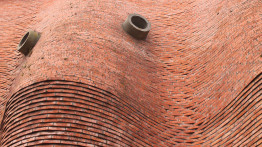
This lecture by Julián Palacio examines the work of Uruguayan engineer Eladio Dieste and his inventions using reinforced ceramics as a modern synthesis of structure, construction, and form. Situating Dieste within a lineage of structural innovators—from Auguste Fabre and Guastavino to Gaudí and Candela—the talk explores how his work redefined masonry as an expressive medium of lightness and continuity. Drawing connections to Latin American artistic movements such as Joaquín Torres-García’s Constructive Universalism, and theoretical frameworks by Eduard Sekler and Robin Evans, Palacio positions Dieste’s architecture as a profound meditation on perception, gravity, and the ethics of making.
Following the lecture, Palacio will discuss his work on Dieste with Professor Nader Tehrani.
This event is being held in conjunction with Eladio Dieste: Material Tour de Force, an exhibition of Palacio's work on Dieste in the Third Floor Hallway Gallery.
Open to the general public. Registration is required.
This event is made possible by the New York State Council on the Arts with the support of the Office of the Governor and the New York State Legislature.
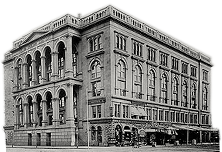
Located at 7 East 7th Street, between Third and Fourth Avenues