Student-Fabricated Structure Acquired by SFMOMA
POSTED ON: July 14, 2025
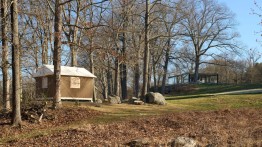
The Paper Log House with Philip Johnson's Glass House in the distance. Photo by Michael Biondo.


The Paper Log House, designed by Pritzker Prize-winning architect and 1984 Cooper graduate Shigeru Ban, has been added to the permanent collection of the San Francisco Museum of Modern Art (SFMOMA). This latest iteration of the structure was brought to life last year by students in The Irwin S. Chanin School of Architecture through a collaboration with Ban’s firm and is the first work from the architect’s portfolio to enter a major museum’s holdings.
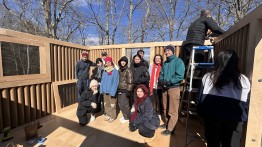
Third-year students in the Spring 2024 Building Technology course, taught by Professor Samuel Anderson AR’82, along with several first- and fourth-year student volunteers, worked from Ban’s drawings to fabricate the components of the Paper Log House in the wood shop and IDC Foundation AACE Lab. Dean Maltz AR’84, a partner at Ban’s New York City office, helped guide the project.
The students then assembled the house as a test on the Great Hall stage of Cooper’s Foundation Building before installing it on the grounds of Philip Johnson’s Glass House in New Canaan, Connecticut, where it was on view from April to December 2024. SFMOMA announced in June that it would acquire the work for its Architecture + Design collection.
Shigeru Ban, celebrated for his pioneering use of paper tube construction, conceived the Paper Log House as a response to the need for temporary housing for refugees amid natural and humanitarian disasters, particularly the 1995 Kobe earthquake in his home country of Japan. His solution was a rapidly deployable structure made from easy-to-source materials, a design that could be adapted to meet local circumstances of disaster relief efforts around the world. In the version built by Cooper students, the house is constructed from cardboard tubes coated with polyurethane for the walls and roof structure, canvas roofing, and a plywood floor secured to a gridded milk crate foundation.
Professor Anderson notes that “the process revealed to the students how tight tolerances are the enemy of facile construction, thus teaching them to value ‘worker-friendly’ detailing in their own designs. It also reinforced the students’ appreciation of solid teamwork.”
For the students who worked on it, the Paper Log House project offered a valuable lesson in translating drawings to a full-scale construction process using materials that needed to fit together precisely. “Troubleshooting and problem solving became very important. Teamwork and organization were instrumental in this project,” says EG Rheams, who was at the time a third-year student.
Meztli Castro Asmussen AR’25 also worked on Ban’s Paper Log House during his fourth year at Cooper. “Because we were building the house at a one-to-one scale, we were able to see how pieces came together in a way that drawings struggle to illustrate,” he says.
Ban himself was drawn to The Cooper Union after studying the work of its renowned architecture dean, John Hejduk, whose theoretical approach has been characterized as “paper architecture.” Both Hejduk’s critical influence and a love for craftsmanship can be traced through Ban’s structural explorations of paper, cardboard, and recyclable materials in the years following his graduation from Cooper. When asked in 2007 about the temporary nature of his buildings, Ban told The New York Times, “If a building is loved, it becomes permanent.”
In 2014, Ban received the Pritzker Architecture Prize in recognition for his innovative contributions to disaster relief work. More recently, he was named a 2024 Laureate of the Praemium Imperiale Award for Architecture by the Japan Art Association.