MASTER OF SCIENCE IN ARCHITECTUREㅤㅤㅤㅤSPRING 2025
GRADUATE RESEARCH DESIGN STUDIO II
Diana Agrest, The Irwin S. Chanin Distinguished Professor
Foivos Geralis, Adjunct Instructor
THE BODY
Corporeal Boundaries: Movement, Time, Space
This studio approaches the question of the body in its articulations and intersecting boundaries from a critical perspective.
It is through focusing on the body as an object of study that architecture and architectural discourse articulates itself with other discourses and disciplines in a constant oscillation between the real object, the body, and the body as an object of study—opening questions ranging from socio-political, cultural, economic, environmental, gender, and representational, etc., that bear on the modes of construction and conception of bodies.
Through narratives generated by focusing on the human body we can transcend (critically) the original preconceptions established in our architectural unconscious (ideology) based on the foundational texts and principles of Western architectural theories such as Vitruvius and Renaissance theories and representations of the body.
Fast forward to the first half of the 20th century and all forms of architectural constructions of the body—from Ernst Neufert's Architects’ Data of 1936 to Le Corbusier's The Modulor of 1945 and also 1955—present narratives of control of the body in space conceived as a machine in a prevailing technocratic ideology, and the body as a tool for consumption and control.
This technocratic ideology takes its extreme form in the second half of the 20th century—with the impact of systems theory, cybernetics, mediatization, and in general, virtual reality—and into the 21st century, and the predicted culture of disembodiment brought about by its mediatization as a result of which the body becomes in its many forms of representation a simulacrum itself.
Or one could look at the body in its corporeality and the pushing of the limits of the body itself, as in athletic activities and all mode of extreme explorations, or the overcoming of its boundaries through the means of possible extensions, from those related to the senses to parts of the entire body through the possibilities afforded by constantly changing and advancing technologies that have gone from the mechanical to the digital, including prosthetic devices, some remedial and some just expansive per se, in a cyborgian transformation so vividly prognosticated by Donna Haraway; or the body relative to the myriad organisms that interact and affect it from within and from without; or focus on the sensorium, the essential human quality.
But again, as bodies are subject to constructions and representations one must ask what body is the body in question. The question is that of difference as opposed to the universalization of an abstract (male) body. Differences of all kinds, from genetic to cultural, including questions of sex, gender, race or ethnicity, and others. This body is also affected if not completely determined by socio-political, economic, cultural, ideological, and physical environments, and enacted in diverse places and modes of habitation, from the physical body to culture of disembodiment in the cyberspace we inhabit, exacerbated at the present time.
This exploration takes as a point of departure individual interests and narratives and conceptualizations through which each project is developed as a creative and seamless process with no separation between explorative research and proposals. Central to this process is an emphasis on the question of representation.
Film was the point of departure for this exploration, as film has recorded and represented the complexity of the body through narratives and contexts of different kinds better than any other medium recording the performative and sensorial aspects of the body in its corporeal boundaries and intersections in movement through time and space.
< Back to Selected Graduate Design Studio Projects
Projects
Spirals of Perception in Flight
Kipras Kazlauskas
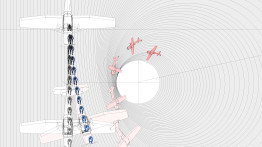
The project is exploring spatial disorientation in flight. The speeds and altitudes at which airplanes fly are more than unnatural for our perception apparatus. With every increase of acceleration our field of vision narrows down. With every slight shift in flight angle and slight tilt of a plane our vestibular apparatus fails to adjust and gets confused. Eventually, lack of clear visual reference leaves us floating in the mid air without a clue where is up, where is down, how fast and how high are we moving. Many plane accidents are attributed to the pilot’s utter trust in their sensorial, guiding the flight. Relying on tools and technology becomes crucial.
However, one can never close eyes completely, as malfunctions in navigation tools are unavoidable. Military nature of various spatial orientation technologies comes with a baggage of power to mislead and take over control from a distance. In some peculiar instances the scale and sophistication of modern technology becomes susceptible to external natural phenomena. Cosmic rays, which constantly beam from outer space, interfere with computer circuits up in the air, causing malfunctions in autopilot algorithms.
The act of flying produces a peculiar state of being. From the moment we are misguided either by our internal sensorial, or by the external technological system, there’s a split in body and space. A doppelgänger of ourselves is created: a version of the real body in a metal enclosure flying through air, and a version of the perceived, slowly drifting away from the real.
Time of the Body: Menstruation as Temporal Knowledge
Nursena Çolak
This project reframes the menstrual cycle as bodily time, a situated record that registers environmental conditions through its synchronicities and irregularities. It emerges as a cyclical and affective form of time, sensitive to external factors such as light, pollution, and travel.
Studies in chronobiology reveal that circadian rhythms regulate ovulation, meaning that the absence of morning light or shifts across time zones can delay the cycle. Similarly, exposure to pollutants can disrupt menstrual regularity. The lunar cycle also shows weak yet measurable correlations, suggesting a possible evolutionary attune to lunar rhythms.
This project offers a way of understanding the interdependence of bodily and ecological systems. Rather than functioning as a passive biological clock, the menstrual cycle is a form of time itself: not linear or mechanical, but cyclical, fluid, and embodied. Time flows with endometrial growth and shedding and the rise and fall of hormones, as a “gynecological-ecological” record, reflecting the interconnectedness of body and world, from the lining of the uterus to the rhythms of the universe.
Protecting the Body in an Ecology of Fire
Vi Phan
This project considers the conditions of the body while fighting fires during the recent Palisades and Eaton Fires in Los Angeles. As wildfires expand and encroach on the built environment, the role of the fire fighter is studied to understand the toll that is exacted onto the body in these extreme conditions. Physical and psychological strains stem from a condition of temperature, both external and internal to the body. Studies of movement, site conditions of wildfires, and wildfire management tactics reveal the intensity and strain that is inflicted don the body of those out on the front lines of wildfires. This project therefore seeks to reimagine the suit as a form of protection that is insular to the body and its own ecosystem in the face of ecologies of fire. The existing suit protected the body, but it came with the constraints of weight, restriction, and trapping heat. So the project proposes a new suit that incorporates elements from space suits, like lighter fire resistant materials, and liquid cooling suits to help regulate the body during a large scale fire. The project also brings attention to the degree in which the body relies on mechanical attachments and additions to it in order to face these extreme environments. This is shown in the suit design which refers to space suit designs, while visually scaling up the impression of these non-human elements that help regulate the body in extreme conditions.