MASTER OF SCIENCE IN ARCHITECTUREㅤㅤㅤㅤFALL 2025

GRADUATE THESIS
Michael Young, Dean; Associate Professor
Ralph Karam, Instructor Adjunct
WHAT IS CONTEMPORARY?
To propose a thesis is to ask a question. To work through a design thesis is to ask the process of creation to steer, divert, reflect, and problematize this question. Developing a design thesis in a specific discipline requires knowledge, research, and positioning within that discipline's discursive framework to challenge the conventions that construct its apparent stability. A thesis does not seek to conclusively answer the initial questions which set it on its way; in the most exemplary instances, it resolves itself into a different set of questions informed by the labor and objects of design. To situate this work, one must engage the pressing issues of one's time. We must ask: What it is to be contemporary?
Over the course of the semester, each student developed a self-driven and defined architectural design thesis. The projects were expected to address a set of contemporary issues through creative work, formulating new questions as to how architecture is transforming—how it can be engaged, understood, and further transformed by design speculations. This work is viewed both as an expansion of the student’s personal concerns and as an addition to the collective knowledge of the studio, the school, and the discipline.
The relationship between architecture as a built physical reality and mediations as a representational reality is as charged today as it has ever been. Shifts in technologies have brought the media for making buildings and making images seemingly closer than ever, yet at the same time, the distribution of information through media has trivialized the imaging of the world. Climate change has impacted all levels of architecture, be they material, social, aesthetic. Political conflict and social inequity are as rampant as ever and architecture is embroiled in these concerns in multiple ways. It is our reality. Architectural discourse is necessarily affected by these issues in the methodology of design, the dissemination of ideas, and the address of an audience. One of the key components of a design thesis project is how you share your work with others as an ongoing discursive proposition. One of the questions informing all architectural mediations is: How do we communicate, or in other words, how does one make one’s views public? The construction of a contemporary architectural thesis must engage these conditions.
< Back to Selected Graduate Design Studio Projects
Projects
On Material Value Speculation
Kipras Kazlauskas
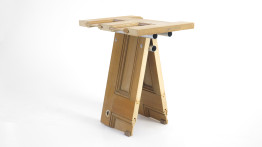
What adjacent worlds are constructed backstage in a throwaway society, and how can we establish new meaning within this constant flow of unwanted matter? On Material Value Speculation investigates how modernist theories accelerated contemporary material accumulation.
Vitra, as both a furniture producer and a modernist institution, serves as the primary research subject. Challenging its factory-made aesthetic, this thesis argues for material maintenance and patchwork design. A traditional sales catalog is transformed into a "junkyard catalog" to subvert material value—from trash back to resource. Ultimately, the project advocates moving beyond mere surface aesthetics, prioritizing value created through active engagement in maintenance, care work, and repair.
Eye for Resemblance: A Study on Gift Wrapping
Tzu-Kuan Liao
A is like B. The act of design is not invention, but recognition. In this project, form is captured through wrapping—folding, covering, and occasionally disguising familiar objects until something unfamiliar emerges. Through gift wrapping, I uncovered—and perhaps even covered—questions of form by recognizing, resembling, and drawing connections: judgments of meaningful differences that begin to form within the observer. The project ends where it began: a Christmas gift swap.
The Fugitives of Leviathan
Zoen Huang
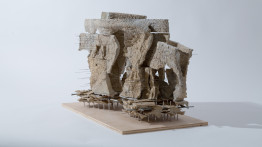
Architectural creation is not merely a moment of inspiration at the drawing table, but a complex process of translation from concept to construction. Drawings became authoritative not because of the lines themselves, but because they embody contractual relationships that regulate architectural production. Through Thomas Hobbes’ metaphor of the Leviathan, this contractual system can be understood as both productive and oppressive. With digitalization, drawings have transformed into precise fabrication protocols, further reinforcing the control embedded within architectural contracts. Yet, as Robin Evans argued in the pre-digital era, architecture has always contained asymmetries and deviations. This research explores how material uncertainty and error, rather than being eliminated, can instead become generative forces within contemporary digital fabrication systems.