Ten Mat Buildings
Mon, Mar 9, 5pm - Sun, Mar 29, 2026 7pm
Add to Calendar
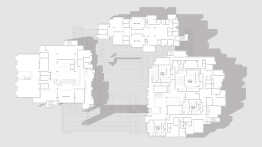
Orange County Government Center | Goshen, NY (1971). Paul Rudolph, Architect. Drawing by Belinda Lin.
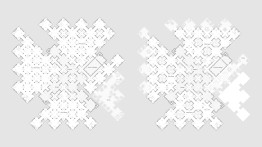
Centraal Beheer | Apeldoorn, Netherlands (1972). Herman Hertzberger, Architect. Drawing by Kristen Jiang.
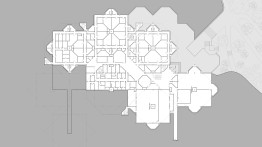
Bowen Science Building | Iowa City, IA (1972). Walter Netsch, Architect. Drawing by Katherine Sazhin.
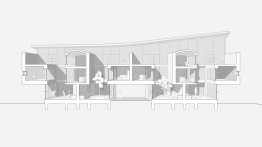
Nexus World Housing | Fukuoka, Japan (1991). OMA/Rem Koolhaas, Architect. Drawing by Kampion Hu.
“Mat-building can be said to epitomize the anonymous collective” [1]
—Alison Smithson
This exhibition presents student work from the spring 2026 Design IV option studio led by Brennan Buck, a visiting faculty member and the 2025–26 Feltman Chair in Architecture. Buck’s studio is exploring the potential of mat-building—a 50-year-old architectural strategy—to stage contemporary forms of social collectivity and shared work, knowledge, and experience. Shown in the Third Floor Hallway Gallery, the exhibition includes ten layered plan-reliefs documenting mat buildings, built between 1955 and 2018, that students analyzed as design precedents during the first weeks of the semester. Additional documentation, drawn by the students, describes each building in detail, often to an extent unavailable from existing sources.
At first glance, Alison Smithson’s 1974 essay “How to Recognise and Read Mat-Building” appears to mark the conclusion of a late-modern idea that was soon overshadowed by postmodernism. Closer inspection, however, reveals sustained architectural interest and a series of built examples that extend from late modernism through the “field conditions” of the turn of the century to contemporary practices such as SANAA and Neri & Hu. In our current social and political context, mat buildings offer an alternative mode of inclusion and collective agency: Smithson’s “anonymous collective” is generated through organizational cohesiveness and interconnection rather than through architectural identity.
Despite the resonance of mat-building today, we inhabit a vastly different social world, global environment, and urban landscape than Smithson did. The studio therefore reconceives several fundamental aspects of mat-building:
1. The late modern period saw Western societies and cities spread out to accommodate mass-
consumer culture and transportation technology. Proliferating automo biles, household
appliances, radios, and televisions all enabled or demanded physical separation and
geographic dispersal. This sprawl typically treated sites as ‘empty’ and infinitely available.
In contrast, the studio practices a more contingent repurposing of the urban landscape,
treating buildings and materials on site ‘as found’, with the potential to be partially
maintained, reused, and repurposed. Given the impacts of gentrification, we are exploring
ways of interconnecting and integrating new buildings into the existing urban fabric.
2. The architects of Team 10, including Smithson, saw significant potential in mass production
and modularity (façade panels, structural elements, and entire rooms). Most early mat
buildings are primarily concrete, a material whose environmental costs were not widely
apparent at the time. Now, the repercussions of limitless production and modern materials
are clear. Students are researching and exploring the potential of biological materials as
structural and insulating alternatives to concrete. Beyond their technical performance,
masonry, stone, earth, mass timber, straw, hemp, and cork also transform how we think
about architectural conventions, particularly poché.
3. The architects of early mat buildings, like their Metabolist contemporaries in Japan, saw
great potential not only in flexibility but also in the dynamism of the building itself.
Architecture was conceived primarily as infrastructure that could literally grow and change.
Flexibility and the accommodation of social and programmatic evolution remain crucial
today, but the dream of short-lived, replaceable components and mobile capsules never
materialized. The studio treats architecture as a more stable material artifact and as an
aesthetic and social/political form. We are relying on Caroline Levine’s cross-disciplinary
definition of form as a kind of agency that links the design of objects and spaces to social
structure, hierarchy, inclusion, and exclusion. This entails the close study of individual
spaces in the proposed buildings and how they stage activity, view, and light.
As the recipient of the Feltman Fund—a gift by Ellen and Sidney Feltman to explore the practical, philosophical, and aesthetic attributes of light and illumination—the studio is devoting particular attention to a key problem raised by the mat building typology: how to daylight extremely deep floorplates. This necessity produces the consistent porosity in mat building plans that, in turn, produces social hierarchy (gathering vs. more private spaces) and experiential variety. In contrast to the predominance of the grid in nearly all mat buildings, a close study of lighting suggests explorations of projection and perspective—the geometry of both light and of view. Smithson thought about mat buildings as being fundamentally non-visual, urging us to wear “protective-visual-clothing” and “deliberately not look too closely” in her essay. This amounts to the final aspect of mat building the studio questions: how can techniques of projection, illusion, and light enliven the extended spaces of a city-block-sized building? This is being explored through both digital and analog means: precise techniques of digital projection and mapping in Rhino and large-scale physical models documented through photography.
[1] Smithson, Alison. “How to Recognise and Read Mat-Building.” AD, September (1974): 573.
__________________________
Held in the Foundation Building’s Third Floor Hallway Gallery.
Open to the general public
Monday – Friday, 12 pm – 7 pm
Saturday & Sunday, 12 pm – 6 pm
Located at 7 East 7th Street, between Third and Fourth Avenues