The Edge of the Practice
Thu, Jan 29, 2026 5pm - Sun, Feb 22, 2026 6pm
Add to Calendar
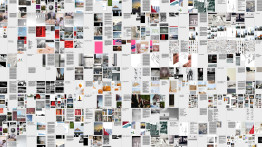
Spreads, Strange Primitivism (The Architecture Observer, 2020). Designed by Haller Brun.
The Edge of the Practice is an exhibition in three parts: a book, a film, a competition submission. Together, they form an atlas of fragments that represents the work of the Office of Adrian Phiffer at the fringes of the traditional practice of architecture. While each piece develops its own discourse on architecture and its media—text, moving image, physical model—that is not the point. Of importance is their capacity to speak unapologetically about the beauty of crisis when an architecture practice takes the shape of a donut: empty at the center for lack of work, delicious on the edges because there is always work.
Part 1, Book
Strange Primitivism (The Architecture Observer, 2020)
Conceived in collaboration with Hans Ibelings and the graphic design studio Haller Brun, the book is guided by a simple ambition: to construct an anti-monograph through rapid movements between layers of architectural anxieties, doubts, fixations, ambitions, regrets. It takes the form of a chubby volume, a brick of sorts, yet it behaves like an open field that can be entered at any page with no consequences for understanding. Reckless and intense, everything in Strange Primitivism is desperately urgent. The details don’t much matter. This wildness, this seeming unruliness of its manner runs against something slower and thicker, an insistent question related to architectural offices making books: For whom are architects still writing?
Part 2, Film
Hero of Generic Architecture (2020)
Conceived in collaboration with Angela Cho, Matthew Leander Kalil, and Avi Odenheimer, Hero of Generic Architecture is a film in five parts told in letter form. Because the nature of the film is to make its subject specific, non-generic, it struggles with its own medium. In such light, its method can only be that of repetition: as a double of history—artistic creation simply reiterates universal creation. Hilberseimer repeats himself, unwittingly, in an architecture office in Toronto, in 2020, and so too does the local architect. And if generic architecture is not a concept but a swarm of objects which are aesthetically insufficient, Hero of Generic Architecture wants to embellish them, only to discover that the subject acquires beauty at the moment of its defeat.
Part 3, Competition Submission
New Landscape Installation on Saint-Catherine Street East, the Gay Village, Montreal (2019)
Conceived in collaboration with Transsolar KlimaEngineering New York and Silman Structural Engineers, this submission is a ten-meter-diameter cylinder, one kilometer long, levitating five to seven meters above the ground. Made entirely of ETFE (Ethylene Tetrafluoroethylene), the installation behaves like an instrument that is, essentially, a void: a space carved in the middle of the city. It is a study of ambiguities and blurred boundaries, and, consequently, identities. What is inside, and what is outside? What is big, and what is small? Its scale and form would make it belong to the world of massive infrastructure, were it not so buoyant as to float. But, of essence, during the competition process—and, here, in this exhibition—was its representation in front of the jury committee. We believed it had to be an effort that projects the installation’s plausibility in the physical world. Therefore: not a flat representation, not an unbearably happy rendered image, but a scaled organism.
In conjunction with this exhibition, Adrian Phiffer will present a lecture—Urbanism, After All—on February 5, 2026.
__________________________
Held in the Foundation Building’s Third Floor Hallway Gallery.
Open to the general public*
Tuesday–Friday, 12 pm – 7 pm
Saturday & Sunday, 12 pm – 6 pm
*The Foundation Building and exhibition will be closed to the public on Friday, February 13 and Monday, February 16.
Located at 7 East 7th Street, between Third and Fourth Avenues