Meet Irene Cheng
POSTED ON: December 1, 2025
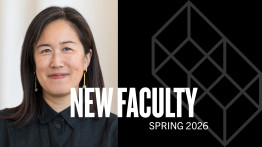
Photo by Nicholas Bruno
Architectural historian and critic Irene Cheng joins The Irwin S. Chanin School of Architecture as associate professor in January 2026. Cheng, who most recently served as chair of the graduate architecture program at the California College of the Arts, will focus on history, theory, and criticism in architecture. The author and co-editor of several books on architecture history, she is currently working on a book that explores the political ecology of Arts and Crafts architecture. Cheng has a B.A. in social studies from Harvard University and M.Arch and Ph.D. degrees from Columbia University.
Tell us about your research interests
Broadly speaking, my research explores the entanglements of architecture, culture, environment, and politics in the nineteenth and early twentieth centuries, with a focus on the United States. My most recent book is The Shape of Utopia: The Architecture of Radical Reform in Nineteenth-Century America (University of Minnesota Press, 2023). It investigates a series of curious utopian proposals put forward in the middle decades of the nineteenth century by reformers affiliated with movements such as anarchism, abolition, vegetarianism, labor, spiritualism, and more. All of these utopias were notable for their distinct geometries: they included hexagonal cities, oval and octagonal houses, and circular temples of commerce. The question I try to answer is why. What connection did these mid-century reformers see between architectural form and politics? And what might that suggest for the broader relationship of aesthetics to politics today? What’s more, how do we understand the relationship of such utopian designs on the American continent to settler colonialism?
For many years I have also taught and researched how theories of race were influential in the emergence of what we think of as modern architecture. This research led to the publication of Race and Modern Architecture: A Critical History from the Enlightenment to the Present (University of Pittsburgh Press, 2020), a book that I co-edited with Charles L. Davis II and Mabel O. Wilson. The book drew on a collaborative effort by scholars from around the world who were working on this topic at a time when relatively few were doing so. It argues for a rethinking, if not dismantling, of some of the core values and assumptions of our discipline, including notions of order, rationality, evolution, and progress.
More recently, I have turned my attention to the histories of building materials as a way of understanding architecture’s relationship to environment, extraction, labor, and experience. I’ve been teaching a course on the history and politics of materials and have also been working with several other historians on a new collaborative project called The Materialities of Empire. I’m excited to discuss these issues with my new students and colleagues.
What brought you to The Cooper Union?
I love the idea of being in a small and supportive community of curious and committed designers, researchers, and thinkers. That’s the kind of environment I am coming from, and that I want to continue to be part of. I am also drawn to The Cooper Union’s extraordinary legacy of making education accessible to all. It’s an important model in age when higher education costs are skyrocketing and student debt has reached unsustainable levels. College should be free for everyone. Lastly, The Cooper Union has a reverential place in the history of architectural education. It has spawned influential pedagogies and produced many well-known architects and scholars over the years. It is a relatively small school with an outsize impact on the world. I am deeply honored to be joining this illustrious and storied institution.
What aspects of teaching are you most excited about in the coming academic year at Cooper?
I can’t wait to get to know the students and faculty better. During my campus visit, I was impressed by the curiosity and rigor that the students exhibited. Cooper Union students have a reputation for being smart and hardworking, and I’m excited for the conversations we will have in and out of the classroom. I am also excited to be back in New York City (where I was educated and lived for over a decade) and to use the city as my classroom!