Houghton Gallery Reopens with Alexandra Kiss AR’05 Exhibition
POSTED ON: April 14, 2026
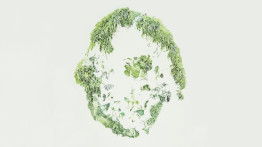
Broken Wreath #1. Acrylic, gouache, and lead pencil on paper. 2023.
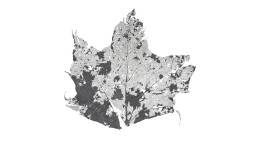
Maple Leaf. Ink on vellum. 2022. Collection of Kyle Blaha and Sean Khorsandi.
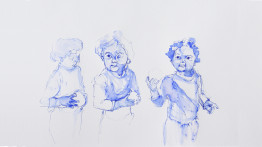
Sophie 7. Ink on paper. 2018-19.
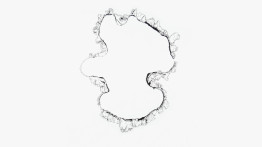
Surface Bark, Cross Section, Crack Willow. Archival pen on acid free paper. 2020. Collection of Ken Andria and Dana Getman.
The reopening of the Arthur A. Houghton Jr. Gallery on April 16 will be marked by a deeply personal and quietly powerful exhibition: a retrospective of drawings by the late Alexandra Kiss, a 2005 graduate of The Irwin S. Chanin School of Architecture, entitled Once in Awe: Drawings of Growth and Decay. Bringing together works from across her career, the exhibition offers both a tribute and an intimate window into a practice that evolved with remarkable sensitivity and rigor.
Kiss wanted to understand how to represent growth and decay in drawing, a challenge requiring an articulation of boundaries where none might exist. “There is no boundary to what is nature and natural processes, but in our attempt to understand things we try to draw those boundaries, which can be useful as a framework to break things down and understand them,” said Amir Shahrokhi, Kiss’s husband, a fellow 2005 Cooper graduate and one of the exhibition’s curators. “For Alex, it was a continual back and forth.”
Born in Romania and raised in Toronto, Kiss earned a Masters of Architecture at Yale after graduating from Cooper. But as Shahrokhi explained, architecture was never Kiss’s true vocation, more of a practical avenue that would let her channel her talent while finding a way to make a living. When their daughter Sophie was born in 2017, she decided to shift her focus to drawing. “I find now [as a mother] that aspects of the professional world are unattainable and even undesirable for myself and I suspect for many women with families,” she once wrote. “Pursuing in-depth work is, and has been, subject to a fragmented focus based on nap-lengths, child caring activities, limited movement, and resources.”
As a result, she decided to pursue what she called a “self-imposed artist residency between November 2018 and November 2019, in order to produce work under the stress of the general upheaval that parenthood brings. Since my constant companion is my growing daughter, I started to document her growth, discoveries, and playing field, all within the constraints of my schedule as a mother.”
Yet architecture never left her work. Instead, it became embedded in her way of seeing, in the precision of her line, her attention to structure, and her ability to render space as something both analytical and deeply felt. Working primarily in graphite, archival ink, and gouache on paper and Mylar, Kiss developed a body of work that is at once meticulous and atmospheric. Over time, her drawings found collectors and commissions, but they retained an introspective quality, grounded in observation and sustained looking.
Flora figure prominently in the show, which is organized into three thematic groupings: growth, decay, and motherhood. Organized by Shahrokhi, Steven Hillyer AR’90, director of The Irwin S. Chanin School of Architecture Archive, and two close friends of Kiss, Laila Seewang AR'05 and Sony Devabhaktuni AR'03—also Cooper Union graduates—the exhibition reflects the deeply intertwined personal and artistic communities that shaped Kiss’ life. She and Shahrokhi were part of a generation of Cooper students who would go on to form lasting creative networks, including friendships with members of Situ Studio and figures such as Brad Samuels AR’05. Some of these peers, including Devabhaktuni, Samuels, and Seewang will contribute drawings to the exhibition, situating Kiss’s work within a broader milieu while underscoring her singular voice.
The installation, which includes student drawings, unfolds across multiple spaces. One section, entitled "Growth," focuses on Kiss’s sustained engagement with trees, particularly her striking studies of bark. These works often take the form of cross-sections, revealing the layered complexity beneath the surface. Hillyer has noted, “She had the eye of an architect—only an architect would think about a cross section of tree bark.” These drawings are not merely observational; they are structural investigations, rendering organic matter with the analytical curiosity of someone trained to think in section and elevation.
The drawings on decay explore fragility and transformation. On one occasion, her toddler daughter gave her a fallen leaf, prompting Kiss to look at it from the perspective of a child, an approach that sees the everyday with awe. She rendered a collection of fallen leaves in extraordinary detail, often offering a magnified view but on paper or Mylar measuring as large as 30 by 40 inches. Veins, tears, and subtle gradations of decomposition are captured with a patient, almost forensic attention. These works slow down perception, inviting viewers to dwell on processes that typically go unnoticed.
For instance, she tracked a decaying tree at the Old Salmon River in Oregon in October 2022. She conceived of it as a “nurse log,” a dead stump that was fostering new life. She unfolded the elevation of the stump and drew only the new growth emerging from the stump and along the base of the trunk, and at the same time, drew it in plan. She returned in April 2024 to find the same log, much changed. This time, according to the exhibition text, “the unfolded elevation shows only the woody debris we might call decay: the fleshy eruption of timber that falls from the stump. The scale this time is unclear—it could be a mountain. We only know its scale once we know that this is the same nurse log painted in 2022.”
The final section, centered on motherhood, introduces a different register. Here, Kiss turns her gaze toward her daughter, Sophie, now eight years old. Artist and educator Sue Gussow, who taught Kiss in advanced drawing courses and included her work in a book on drawing, contributes a written reflection for the exhibition, focusing particularly on these maternal works. She asks, “The work of an artist demands time and requires space. In the fullness of motherhood, where is the space that the artist, Alexandra Kiss, must find?”
A table within the gallery will display books and research materials that informed Kiss’s practice, offering insight into her intellectual world. She read extensively about nature as well as art, inspired by the work of Rachel Carson, Josef Albers, William Dunning, and Irene Kopelman, as well as ecological fiction.
Kiss’s work has been exhibited in juried exhibitions and art fairs in Toronto, and Picton, Canada; in Cincinnati, Ohio; and in Fort Wayne, Indiana. Her work is now held in private collections in Canada, the United States, Hong Kong, France, Switzerland, and Ireland. Her drawing has been featured on the cover of Architectural Theory Review, Volume 25, Numbers 1-2, published by Routledge, and in E-flux’s issue on Accumulation.
Ultimately, the exhibition is not only a memorial but also an argument for drawing as a sustained practice, and for the expansive possibilities available to those trained in architecture. Hillyer hopes that students will see in Kiss’s work “what is possible for their work beyond what could be a straight shot to practicing architecture.” And more than that he and the curators anticipate that in looking at her extraordinary body of work, all visitors will experience wonder, an emotion Kiss called “a transformative emotion.”
Opening reception: Thursday, April 16, 6:30 pm
Exhibition hours: Tuesday – Sunday, 12 pm – 7 pm