Cooper Alumnus Behind Suffolk County 9/11 Memorial
POSTED ON: September 9, 2026

Cooper Union graduates have been behind some of the most notable and moving tributes to the victims of the September 11, 2001, terrorist attacks, including Daniel Libeskind AR’70, who designed the World Trade Center memorial’s master plan, and Julian LaVerdiere A’93, who helped create “Tribute in Light,” a memorial of blue lights emanating from the site of the Twin Towers.

Add to that list the work of Barry Silberstang, an architect who graduated from The Cooper Union in 1967. Silberstang designed Suffolk County 9/11 Memorial, also known as Gardens of Remembrance, which was dedicated in 2009.
“As I contemplated the idea of a memorial to the 9/11 attack, I was never comfortable with the idea of building a monument to the destruction of a building. For me, the memorial had to be only about the victims,” says Silberstang. The news in those first months after the attacks were filled with reports of people for whom there were no remains. What that means, he says, “is that those victims had no burial site,” nowhere for family and friends to mourn. That absence drove his design, which set out to provide a physical space dedicated to each of Suffolk County’s 178 victims.
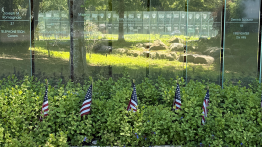
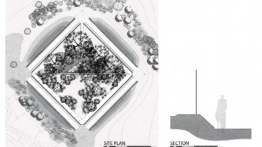
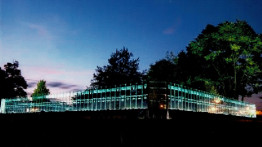
From a distance, the memorial, a one-acre site located in Armed Forces Park in Hauppauge, New York, is a subtle frame of transparent panels that sits lightly on the manicured landscape, catching light and reflecting it in shifting patterns. As visitors get closer, they begin to see the names, ages, and jobs of those who died etched into each of the 24-foot-wide Lexan panels, largely men and women in their 30s and 40s who worked as traders, technicians, designers, administrative assistants, and firefighters. The list includes a father and son who died as FDNY first responders to the North Tower, Joseph Angelini senior and junior. Taken as a whole, the panels make up a chamfered square like the footprint of the towers themselves. Visitors look through the panels into the inaccessible Garden of Remembrance, which can be seen but not entered by visitors. “This space belongs only to the victims,” says Silberstang.
The interior garden was designed with plants indigenous to Long Island in a naturally random arrangement to contrast with the manicured lawns surrounding it, a “garden that would grow to mark time,” Silberstang says. In 2003, the year he was awarded the commission, he told amNewYork. “You’ll see growth symbolizing the things that didn’t happen, the lives that weren’t led. Years from now this growth becomes a powerful visual representation of what was lost.”
The result is a memorial that balances memory with nature, its impact changing with the seasons. The inscribed Lexan walls are more visible during winter against a bare-tree landscape, while in summer the background is local bushes and trees. At night, the up-lighting illuminates the edges and graphics. In all seasons, it’s a place for family to leave flowers and notes, with each panel functioning in lieu of a headstone. The memorial’s poignancy is driven by the constantly changing views, both the untended interior garden and the outer landscape reflected in the panels.
Silberstang’s career included working for Thomas Aidala, Peter Eisenman, Richard Meier, and Charles Gwathmey. John Hedjuk was his design professor for four of his years at Cooper. His work was included in the seminal Education of an Architect: A Point of View exhibition at the Museum of Modern Art in 1971. “Cooper Union brought me here,” says Silberstang. He has practiced in Manhattan for over 34 years.
He founded Silberstang Architects in 1988 and merged with Arthur Lasky in 2005. After entering Suffolk County’s design competition for a 9/11 Memorial in 2002, Silberstang Architects was commissioned to complete the design and see through the construction.
Today, the memorial, which was largely constructed by volunteers motivated by the project’s mission, provides family and friends with a place to see their loved one commemorated and, with its shimmering panels framing space just out of reach, provides a contemplative experience for all visitors.