MASTER OF SCIENCE IN ARCHITECTUREㅤㅤㅤㅤFALL 2024
GRADUATE RESEARCH DESIGN STUDIO I
Benjamin Aranda, Assistant Professor
The Tree Studio focused on research and experiments exploring the history and contemporary possibilities of whole tree construction. Whole tree construction is what it sounds like: building using whole tree parts, not exclusively lumber. The Tree Studio delved into the nature of building with non-standard parts—idiosyncratic elements that resist conventional assemblies and construction. Students located these experiments in a New York City park, reimagining the beloved and typical public buildings associated with park infrastructure. Against this backdrop of a tree-building in a park in a city, the studio invoked the urban environment’s connection to larger ecologies. The use of whole trees to anticipate new kinds of public spaces in New York City parks is itself a microcosm, or model, of larger ecological challenges. While the program and location of this intervention was entirely up to each student, the conceptual framework for the entire studio was a shared interrogation of the Tree as a physical and scalar representation of the world. It was both the thing and the model of the thing that we were interested in.
< Back to Selected Graduate Design Studio Projects
Projects
A Non-Standard System: Tree Structure Landscape on Water Infrastructure Inspired by Chinese Calligraphy
Eric Honghao Zhao
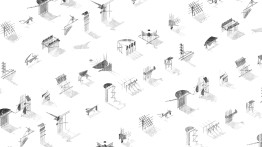
This project explores a non-standard landscape system that integrates tree structures with water infrastructure, drawing inspiration from the modular logic of Chinese calligraphy.The Chinese writing system, unlike the alphabetic system of English, is not based on a fixed set of 26 letters but is constructed from eight basic strokes that form complex, variable characters. This modular yet open-ended structure offers a design methodology that embraces instability, variation, and possibility. Adopting this logic, I developed a system that treats trees not as standardized building materials, but as irregular elements.Rather than processing trees into uniform forms, I explored how their natural geometries could inform joint design. Inspired by the composition of Chinese characters, I created a set of joint typologies that respond to the unique shapes of individual trees.
In parallel, I investigated how water is transported into New York's Central Park and was drawn to the temporary wooden structures built atop infrastructural systems—making the inaccessible tangible and human-scaled. I propose that minimally processed, non-standard tree elements can be used similarly: as an interface between engineered water infrastructure and human experience.Using a modular logic akin to Chinese calligraphy, I designed a system of 20 unique tree-structure “characters.” Each one offers a distinct landscape experience—such as ascending, descending, or resting platforms. These elements can be deployed like components in a construction manual, allowing designers or builders to adapt them to specific site conditions and spatial intentions.
Fabricated Forest
Kipras Kazlauskas
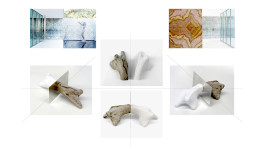
Timber architecture is almost unimaginable without dimensional lumber, which provides nearly endless flexibility in project design and scale. Planned and squared timber often acts as a desirable mediator between the cold, rational nature of modernist architecture and the “naive” aesthetic of full-wood structures. This project, however, attempts to push back toward the folk full-tree-architecture, seeking new aesthetics, questioning the necessity of total control in design, and celebrating the complexities of the found object.
One of the main byproducts of the lumber industry are the crooked parts of trees, especially the nodes, which don’t fit well into standardized milling machinery. Although they are incredibly smart structural elements, such parts are often discarded as waste. This project began as a collection of these wooden nodes, investigating various structural combinations of these found objects.
A digital archive was created by 3D-scanning each wood piece, allowing for the manufacture of identical copies. The project then continued by juxtaposing these actual wooden nodes with their mirrored 3D-printed duplicates, exploring the space between the real and the fabricated. Adding shiny, reflective metal surfaces opened a dialog between virtual “reflected spaces,” the original objects, and their mirrored clones. Splitting the wooden pieces revealed yet another layer of symmetries. The final models of the Fabricated Forest are fragments of potentially endless spatial configurations, saturated with symmetries and self-resemblances. In this way, the raw “real” comes into dialog with the whitewashed “ideal.”
Decentralized Growth—Between Tree and Rhizome: Deconstructing Hierarchy with Blockchain
Zoen Huang
Trees are not only a type of plant but can also be seen as a visualized form of social structure. Applying Mary Douglas’s Grid-Group Cultural Theory, the form of a “tree” corresponds to “hierarchy.” However, this framework includes other social formations as well. I used parametric models to digitize these structures and, more importantly, to mathematically represent how they transform to each other. Through analysis, I extracted three key typologies—grid, tree, and rhizome—and combined them with blockchain logic to propose a tree-branch trading system in New York City. The project unfolds in three phases:
2024 — Constructing:
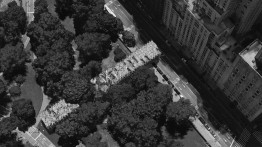
Every year, countless tree branches are cut and discarded in NYC. This system applies digital encryption to assign value to each branch and records them on the blockchain. According to my parametric modeling, people can use these tokenized branches to construct “tree banks”—structures whose forms are not determined by capital flows, but instead by trading histories inscribed in the blockchain.
2028 — Utilizing:
By 2028, the integration of blockchain and IoT has matured. Central Park becomes the physical launch site of the system. Though originally built for public leisure, Central Park has long been co-opted into a mechanism for raising adjacent property values. Based on my research on social structures, I visualized the park’s four peripheries—revealing how hierarchy dominates the entire area. This system aims to insert a bottom-up momentum into the space, counterbalancing top-down urban control.
2032 — Occupying:
Greed is the engine of capitalism, so recurring financial crises come as no surprise. In 2032, another severe economic collapse hits Wall Street. Investment banks go bankrupt. The buildings remain, but they are hollowed out—glass shattered, gaping holes left behind. Mass unemployment forces people into the streets. Eventually, they occupy the New York Stock Exchange, using the tree bank system to organize salvaged materials and, at the same time, build new modes of living.