MASTER OF SCIENCE IN ARCHITECTUREㅤㅤㅤㅤFALL 2024
GRADUATE THESIS
Zulaikha Ayub, Assistant Professor Adjunct
Graduate thesis is an independently led, semester-long, studio-based course that culminates the respective journeys of each student in the M.S. Arch. program. The works presented here are a cross-section of this journey. Embedded within them are the material practices, conceptual scaffoldings, and personal expressions of the world they occupy—and the world which occupies them.
Generationally, these students entered the world around the turn of the 21st century, when the field and practices of architecture were leaning into the techno-liberalisms of digital modeling, starchitect culture, and globalized design. In the years and decades that followed, we came to know a different world—one where environmental disasters, mass displacements, financial collapse, health crises, military invasions, and resurgent forms of authoritarianism not only shape daily life but lay themselves bare in real time and in live feed.
The semester’s approach took its cues from Donna Haraway’s magnificent and groundbreaking formulation in “Situated Knowledges: The Science Question in Feminism and the Privilege of Partial Perspective,” in which she states:
“I would like to suggest a doctrine and practice of objectivity that privileges contestation, deconstruction, passionate construction, webbed connections, and hope for transformation of systems of knowledge and ways of seeing.” [1]
Rather than positioning the thesis project as a linear movement towards a “final” destination, this studio sought to situate both the projects and itself from within the thick, heterogeneous manifold of ongoing negotiation. With an intentional resistance to “single” origins, we began instead from “the middle.” A thesis project is not to conclude, but to complicate—to locate the attractions, repulsions, and stakes of one's investigations and positionings in the world, while working constantly to bring them into new expressive forms. The selections, subject matters, and sensibilities on display offer up different registers in which architectural thinking, as a mode of inquiry, operates.
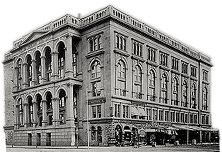
Thesis is therefore less a vehicle for design than a vehicle for epistemology—for refiguring how knowledge is drawn, constructed, and lived: from the visual horizons of Southern Lebanon to the lithic cosmos of Central Park; from the frenetic feedback loops between l’énonçable and le visible in the black box of machine learning to the ancient tectonic craft of interlocking timber; and from the hardened, grotesque organs of urban infrastructure to the halls of this building.
[1] Donna J. Haraway, “Situated Knowledges: The Science Question in Feminism and the Privilege of Partial Perspective,” Feminist Studies 14, no. 3 (Autumn 1988): 575–99.
< Back to Selected Graduate Design Studio Projects
Projects
Identifying Grotesquerie
Fayyaadh Fadzil
Beyond the contexts of its multifarious origin—a genre of art, caricature in theatre, decorative apotropaic devices or ornamental infrastructural appendages—how does the grotesque carry through to today? Questions of ideal form, scale, bodily affect, deformations, and materiality are central to the investigations of the provocative and transgressive nature of the grotesque. This thesis forms the beginnings of a catalogue of contemporary grotesquerie by identifying motifs (faciality and materiality) and functions (apotropaic or utilitarian) of artefacts of contemporary architectures—Siamese connections and surveillance cameras—that are central to the investigations of grotesquerie in the contemporary.
Mulptiple Primitives: Transmediating Language, Image, and Form
Kaiyi Ding
This thesis explores the interplay between language, image, and form within specific digital technologies, including emerging AI tools. Through a broader process of iteration and recursion, nuanced relations— like those of translation and even mistranslation—between text, image, and form were intentionally sought, highlighted, and exaggerated as a critique of the homogeneity pervasive in our contemporary mediated world.