What Else Could It Mean?
Thu, Sep 3, 5pm - Sun, Sep 27, 2026 7pm
Add to Calendar
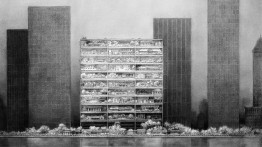
High-Rise of Homes, 1981. Ink, wash, and charcoal on paper, 20 ¼ × 28 ¾ inches.
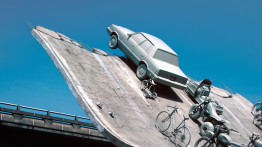
Highway 86, Vancouver, Canada, 1986.
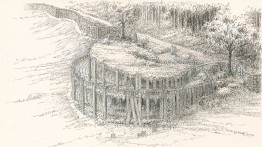
Rossini Sculpture Garden Pavilion, 1999, near Milan, Italy. Pen and ink with correction fluid on paper, 11 × 17 inches.
“An idea that is not dangerous is unworthy of being called an idea at all”
—Oscar Wilde
What Else Could It Mean? Drawings and Writings by James Wines & SITE is a provocation, an exhibition, and a launch event for the book of the same name, featuring an in-person conversation with James Wines, SITE’s founder, Phillip Denny, the book’s editor, and Suzan Wines, executive director of SITE on September 15, 2026.
The exhibition explores SITE’s creative process across six themes, from the prehistory of the practice and the BEST showrooms to De-Architecture, drawing, ecology, and the long life of a single question. Like the book it draws upon, the show refuses retrospective tidying in favor of an ever-inquisitive panoramic sketch.
Drawings from SITE’s archive appear alongside texts, anecdotes and an over-size drawing installation, tracing the evolution of ideas across scales and contexts. Together they reveal the collaborative process foundational to SITE’s work, in which architecture, the visual arts, landscape, green technology, and the surrounding environment are inseparable elements in a unified vision, where buildings and their surroundings are no longer designed as isolated objects sitting in the environment, but rather interpreted more inclusively as the environment.
SITE burst onto the architecture scene with a bang that landed like a “kick in the pants”: the public largely embraced the whimsical showrooms for BEST Products Inc., while the establishment reacted in horror. Leon Krier likened the Indeterminate Facade to an architectural tragedy, while Lebbeus Woods wrote it off as a “one-liner.” Professional acceptance was never the point; as the contractor for the Rainforest Showroom put it, “I'm not saying I like each specific design. But I like that it makes people think.”
The work gathered here is a provocation addressed to a new generation of artists, architects, and designers, an invitation to cross the lines that professions draw.
Credits
The exhibition was organized by Suzan Wines and Phillip Denny with The Irwin S Chanin School of Architecture Archive and The Cooper Union: Craig Branum, Chris Dierks, Eamon Dunbar, Steven Hillyer, Riley Howard, Coco Klockner, Saman Nauman, Paul Ostner, Renato Pasion, Asa Simms, Ninel Shahnazarian, and Ilea Wunder. Special thanks to Evan Craig, Paul Ostner, and Drawing Matter.
Drawings, photographs, and artifacts courtesy of SITE. BEST Products Cutler Ridge drawing (DMC 2288) courtesy of Drawing Matter.
What Else Could It Mean? Drawings and Writings by James Wines & SITE, edited by Phillip Denny, is published by Skira (2026). Copies will be available at an exhibition talk and book launch on September 15, with a signing to follow.
__________________________
Held in the Foundation Building’s Third Floor Hallway Gallery.
Open to the general public
Monday – Friday, 12 pm – 7 pm
Saturday & Sunday, 12 pm – 6 pm
Located at 7 East 7th Street, between Third and Fourth Avenues