John Hejduk: Three Projects
Thu, Sep 11, 2025 5pm - Fri, Oct 3, 2025 5pm
Add to Calendar
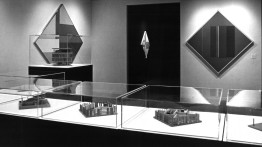
The Diamond in Architecture and Painting. The Architectural League of New York, November 3–24, 1967. Larry J. Wolfe, photographer. Courtesy of Joan Ockman.
“The arguments and the points of view are within the work, are within the drawings; it is hoped that the conflicts of form would lead to clarity which could be useful and even perhaps transferable.”
—John Hejduk [1]
In 1969, at the behest of his students and with support from The Architectural League and the Graham Foundation, John Hejduk published Three Projects as a set of drawings culminating “a ten-year effort and search into generating principles of form and space.” [2] The principle in question was his diamond configuration, a long-standing inquiry into the spatial possibilities that emerge from the axonometric projection of a diamond.
This exhibition—part of an ongoing series of hallway shows presenting material from the Architecture Archive—features the now rare publication in full. Also shown are related correspondence from the Archive; contextual records generously provided by Joan Ockman, The Architectural League of New York, and the Graham Foundation for Advanced Studies in the Fine Arts; and an illuminating essay by Stan Allen.
Two years before the publication, Hejduk presented these three projects in The Diamond in Architecture and Painting (1967), a joint exhibition at the League with Robert Slutzky—a colleague, painter, Cooper graduate, and fellow professor in the School of Architecture. Comprised of Hejduk’s models and drawings, and Slutzky’s paintings, the exhibition explored the “diamond field [as] the ultimate distillation of the first probes initiated by the De Stijl movement.” [3]
As evidenced in the League exhibition, the diamond as a site of investigation emerged from an ongoing exchange between Hejduk and Slutzky, who taught together at the University of Texas, Austin in the 1950s before moving to The Cooper Union. In his introduction to Three Projects, Hejduk traces the shared impetus of the diamond configuration to the De Stijl painters Theo Van Doesburg and Piet Mondrian, beginning with Van Doesburg’s decision in the 1920s to rotate his canvas 45 degrees, and with it the orthogonal relationships of his painting. In response, Mondrian also rotated his frame 45 degrees, but effectively did so around his canvas, fixing within it the original 90-degree relationships of his painted lines. “The formal ramifications of this action were shattering…,” notes Hejduk, “…the peripheric tensions of the edge and contours were heightened and the extension of the field was implied beyond the canvas.” [4]
Stan Allen, in “John Hejduk’s Axonometric Degree Zero” (Drawing Matter, 2019) clarifies both the formal effects of this move—an evenly distributed composition and an activated edge—and its novel implications:
The astonishing originality of the diamond proposition only becomes apparent in the axonometrics, which approximate the effect of the realized buildings but also stand on their own as a complete thought. For Hejduk, the 90-degree projection followed logically from the diamond plan. A text in the original catalogue lays out his thought process. There are many forms of axonometric, but the simplest to construct is a vertical projection from a rotated plan. This means that the plan geometries are preserved, while the elevations are skewed. The usual procedure is to rotate the plan out of square to 45 (or 60) degrees, but in the case of the diamond, the 45-degree rotation brings the bounding box back to the right angle. If the power of the axonometric is to combine in one drawing the measurability of orthographic projection with the pictorial, descriptive character of perspective, the 90-degree axonometric complicates and challenges the descriptive character of the axonometric. It produces an oddly flattened figure on the page.
The resulting work, notably characterized by Joan Ockman as embodying a “painterly and paradoxical frontality,” opened for Hejduk “another way of looking at space and form” as articulated in the drawings on display. [5,6]
[1,2] Graham Foundation Award Statement. Undated (ca. 1967–69). Courtesy of The Irwin S.
Chanin School of Architecture Archive.
[3] The Diamond in Architecture and Painting. Press Release. October 24, 1967. Courtesy of
The Architectural League of New York via the Archives of American Art, Smithsonian
Institution.
[4] Hejduk, John. Three Projects. New York: The Cooper Union School of Art and Architecture,
1969.
[5] Ockman, Joan. “Architecture as Passion Play.” Casabella 649 (1997): 4–9.
[6] Hejduk, John. Three Projects. New York: The Cooper Union School of Art and Architecture,
1969.
Special thanks to Joan Ockman, Stan Allen, Sarah Herda, the Graham Foundation for Advanced Studies in the Fine Arts, The Architectural League of New York, the Archives of American Art—Smithsonian Institution, Daniel Luo, Nora McNulty, Ninel Shanazarian, and Kevin Yang.
Held in the Foundation Building's Third Floor Hallway Gallery.
Open to the general public:
Tuesday–Friday, 12 pm – 7 pm
Saturday & Sunday, 12 pm – 6 pm
The Architecture Archive's programs are made possible by the New York State Council on the Arts with the support of the Office of the Governor and the New York State Legislature.
Located at 7 East 7th Street, between Third and Fourth Avenues