Archigram: Making a Facsimile
Tue, Oct 14, 2025 5pm - Thu, Nov 6, 2025 7pm
Add to Calendar
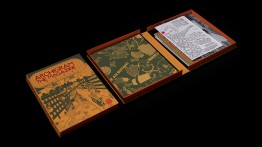
Archigram: The Magazine (D.A.P., 2025)
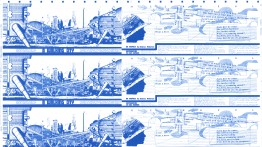
Facsimile running sheet from Archigram 5 featuring Ron Herron's A Walking City (1964)
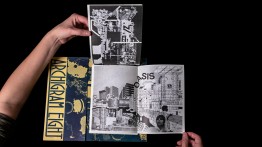
Archigram 8 (D.A.P., 2025)
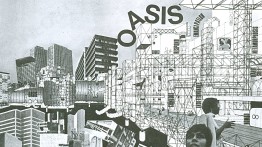
Archigram 8: Collage by Ron Herron (1968)
This exhibition tells the story of a complex and ambitious architectural publication: the first full facsimile of Archigram, one of the most formally inventive, conceptually daring, and historically consequential small-press magazines of the postwar era.
Held in partnership with New York publisher D.A.P., Archigram: Making a Facsimile traces the process of recreating all ten issues of this legendary magazine by focusing on its highly inventive uses of paper—from ingenious folds and cut-outs to wallets, pockets, and pop-ups—while celebrating a feat of bookmaking that remains unrivaled in the history of little magazines.
The brainchild of six young architects born into the foment of the British counterculture—Warren Chalk, Peter Cook, Dennis Crompton, David Greene, Ron Herron, and Michael Webb—Archigram magazine was launched in 1961 as a clarion call for a new generation to embrace experimental technologies and paradigms for living. Over the course of the 1960s, it quickly evolved into an energetic global platform for the architectural avant-gardes of the time, synthesizing influences from comic-book culture, Pop art, psychedelia, Constructivism, sci-fi, and the space race.
The pages of Archigram abound in irreverent energy, contagious optimism, and wild conceptions of what buildings and cities can be. They are packed with proposals for “instant cities” and “plug-in” architecture; they feature pioneering projects by the many architects, inventors, collectives, and theorists with whom Archigram were in touch such as Buckminster Fuller, Reyner Banham, Cedric Price, Haus-Rucker-Co, Frei Otto, Hans Hollein, and the Metabolists. Fun, stimulus, and dialogue formed the magazine’s unspoken ethos, and the allure of that ethos remains as keen today as when its final issue (number 9½) appeared in 1974.
Archigram’s influence has proved enduring, perhaps most famously in its impact on Richard Rogers’ and Renzo Piano’s Centre Pompidou, and on a later generation of nineties and noughties modernists embracing the potential of technology including Future Systems, Foreign Office Architects, Diller Scofidio + Renfro, Anthony Dunne, and Fiona Raby. Archigram’s members have also taught several generations of architects—in particular at The Cooper Union, where Michael Webb was a faculty member from 2010–2017 and Dennis Crompton taught in the spring of 2010 as the Irwin S. Chanin Distinguished Professor.
Archigram stood for fecundity of imagination, riotousness, hilarity, debate, provocation, and hopefulness. Unique in architectural publishing, the group’s magazine represents a fertile collision of architectural and print aesthetics. As such, Archigram remains a trove of inspiration, for students not only of architecture, but also of art and design.
Archigram: The Magazine is copublished by D.A.P. and Designers & Books. The exhibition is accompanied by a panel discussion—Plug In, Fold Out, Pop Up: Publishing as Architecture—on October 28.
In memoriam Dennis Crompton (29 June 1935–20 January 2025).
__________________________
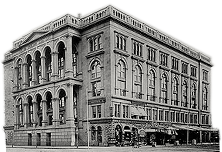
Held in the Foundation Building’s Third Floor Hallway Gallery.
Open to the general public:
Tuesday–Friday, 12 pm – 7 pm
Saturday & Sunday, 12 pm – 6 pm
This exhibition is made possible by the New York State Council on the Arts with the support of the Office of the Governor and the New York State Legislature.

Located at 7 East 7th Street, between Third and Fourth Avenues