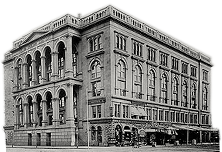
The Irwin S. Chanin
School of Architecture

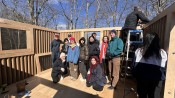
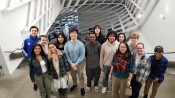
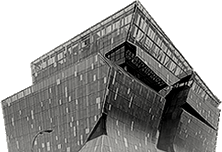
With approximately 150 undergraduate and 10 graduate students, The School of Architecture is the smallest of the three professional Schools of The Cooper Union. The strength and character of the school results from its integration of a strong liberal arts curriculum with a rigorous professional degree program, allowing students to engage in individual research and personal development through a five year studio based curriculum.  The size of the school permits small classes and encourages lively debate and exchange among students and faculty alike.  The School’s position within The Cooper Union as a whole encourages interdisciplinary and inter-professional exchange, while its location in New York City offers students access to extraordinarily rich architectural, urban, and cultural experiences. 

Over the last five years the school has developed the studio curriculum in ways that have reinforced its strong traditions of design and craft while investigating problems that reflect the changing conditions of contemporary practice and the urgent issues of rapid urbanization and the need for environmental and cultural conservation.  In these experiments students and faculty are exploring the potential contributions of architecture to our changing world, redoubling their efforts to explore a positive future for an architecture that is, after all, a discipline of design.  This task does not involve a wholesale rejection of the past – our traditions and historical experience – for what has changed are not the principles, but rather the determinants and the materials of design. We are, indeed, in the process of re-learning the poetics of a space of life: of air and water, of geology and geography, of culture and society, of poetics that lie deeply within these elemental forces.  Even as the poetics of the sublime resided in the electric thunderstorms of Benjamin Franklin, the poetics of movement in the phonograms of Edgar Marey, the poetics of psychoanalysis in the dreamscapes of Giorgio de Chirico, the poetics of narrative in the filmic devices of Eisenstein, and the poetics of topology in the innerscapes of Keisler, so, in response to our heightened awareness of the limits of planetary resources, there is a need for architectural languages that are not simply expressive of a condition, but that work to transform, ameliorate and re-frame the conditions of life itself.   On this re-framing – programmatically, technologically, and above all formally – rests not simply the future of architecture, but of our life in the world.  Gradually, out of this process, architecture, once more, may become a force through which life is transcribed into art in order to enhance life.

  • Founded by inventor, industrialist and philanthropist Peter Cooper in 1859, The Cooper Union for the Advancement of Science and Art offers education in art, architecture and engineering, as well as courses in the humanities and social sciences.

  • “My feelings, my desires, my hopes, embrace humanity throughout the world,” Peter Cooper proclaimed in a speech in 1853. He looked forward to a time when, “knowledge shall cover the earth as waters cover the great deep.”

  • From its beginnings, Cooper Union was a unique institution, dedicated to founder Peter Cooper's proposition that education is the key not only to personal prosperity but to civic virtue and harmony.

  • Peter Cooper wanted his graduates to acquire the technical mastery and entrepreneurial skills, enrich their intellects and spark their creativity, and develop a sense of social justice that would translate into action.