Stacks and Showcases
POSTED ON: May 15, 2026
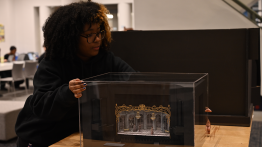
Zekaiya Whittington installing a model of the Todd Haimes Theater by Marsha Ginsberg A’83
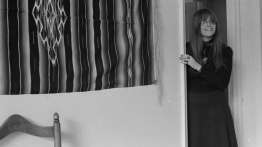
A self-portrait by Marcia Resnick, part of Tay Wright’s exhibition about the photographer, Bad Girl
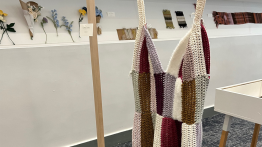
Installation views of the Yarn Club’s Spring 2025 exhibition
This article appears in the Spring 2026 issue of At Cooper magazine.
In Spring 2024, The Cooper Union Library launched a new initiative that reimagines what a library can be: known simply as the Library Exhibitions program, the initiative invites students, staff, and faculty to curate their own exhibitions within the library itself, transforming its atrium and display spaces into platforms for storytelling and collective inquiry.
The program’s approach makes no demands on style or subject, as long as each curator commits to a thoughtful exploration of a subject. The exhibitions have included a show of handmade textiles by the Yarn Club, an homage to the noted photographer and Cooper professor Marcia Resnick A’72, an exploration of theater design, and a show by The Cooper Union Radio Club, among others.
“Students can see themselves in the collections and space!” says Art and Architecture Librarian Mackenzie Williams. “While the librarians and staff know a ton about Cooper and the collection, students bring their current experiences of Cooper and dreams for what Cooper could be.”
The main exhibition site is the library atrium, where a long niche accommodates flat works, leaning objects, and wall-mounted pieces. The library has also expanded its display infrastructure, borrowing vitrines from campus partners and eventually acquiring five custom wooden vitrines built by Arthur Lee, a 2025 graduate from The Irwin S. Chanin School of Architecture, as part of his thesis project, Archives for Loisaida. These resources allow student curators to think ambitiously while working within the practical rhythms of a shared, active space.
The program builds on several years of evolving collaboration between library staff and The Cooper Union community. When Mackenzie Williams joined the library in 2022, she began working with Library Director Lisa Norberg on book displays curated by students and faculty. These early displays—centered on topics ranging from screen printing and LGBTQ+ studies to Latin American art and the Lillian D. Wald Humanities Reading List—opened the door to seeing the library as an expressive space rather than a purely functional one.
By 2023, that idea had expanded further through Williams’s work with Mary Mann, the Archives Librarian, assisting on exhibitions drawn from Cooper’s archival collections. Students, faculty, and staff increasingly engaged with archival materials not just as sources, but as objects with visual and narrative power. A turning point came in May 2023, when Anjanisari Ramadhani A’22 curated Show of Shows, documenting the history of Cooper exhibitions while demonstrating how naturally exhibitions could live within the library space.
The following year, Williams and Mann sought to keep the library connected to the End of Year Show by issuing a call for works related to text, book arts, and writing. Collaborating with work-study student Magnus Gomez A’24, they developed the exhibition Books Without Words and Words Without Books, reinforcing the idea that the library could function as both a scholarly and creative commons. Around this time, a broader framework began to take shape. Williams—alongside Norberg, Assistant to the Director Samantha Berman, Digital Collections Librarian Calista Donohue, and Mann—helped formalize Library Exhibitions as an open, proposal-based program for the entire Cooper Union community.
The library plans to issue a call for proposals each semester, with the goal of hosting approximately three to four exhibitions per year, depending on scheduling and archival commitments. Proposals are reviewed by a small, mock-committee dubbed the Library’s Exhibitions and Events Committee (LEE). Rather than rigid selection criteria, the committee focuses on clarity of vision, relevance to the library, and feasibility. Proposals ask applicants to explain why the project belongs in a library context—how it engages with either specific holdings or broader themes of archives, books, and knowledge. In practice, the biggest constraints are logistical: “The real criteria are space and time—because there’s always something happening in the library!” says Williams. “We have book launches, faculty talks, community discussions, long tables, and sometimes massage chairs and relief dogs!”
While library staff continue to organize their own exhibitions—alongside archival shows, book displays, and semi-permanent installations—student-led exhibitions shift responsibility and authorship. Students take the lead on installation and are encouraged to work with archival materials, meeting with Mann or Williams to learn research methods, safe display practices, and proper citation.
The results have been illuminating. Architectural Acts of Theater, a student-curated show that was mounted in Fall 2025, mined numerous sources, including Cooper’s Architecture Archives and the Schubert Archive, to find a long history of theater design by Cooper Union alumni. These include the school’s namesake, Irwin S. Chanin, who profoundly shaped New York City’s Broadway Theater District in the early 20th century. His work includes the 46th Street Theatre (now Richard Rodgers Theatre), Biltmore (Samuel J. Friedman), and the Majestic, among others. The show included original construction documents of Chanin’s buildings as well as work by other Cooper alumni, including scenic designer Marsha Ginsberg A’81 and Milton Glaser A’51, and archival materials from The Cooper Union Dramatic Club, active from 1939 to 1967.
The show’s curators—Zekaiya Whittington AR’28, Angelis Heredia AR’27, Amira Walcott AR’27, and Mia Press AR’28—all have an interest in curation and theater design as a professional route outside of the traditional architecture firm.
“We wanted to represent work having to do with scenic design, and we were able to acquire a model of Anastasia, a play that was set in the Broadhurst,” said Whittington. “We also included student work from a current architecture studio, studying playhouses in Boston. Lastly, we had books relating to theater from the library since that’s where the exhibition took place.”
That wide-lens approach was balanced by another exhibition last fall that explored the work of one artist alone, student Tay Wright’s presentation of the work of influential photographer Marcia Resnick A’72. Wright, a sophomore art student at Cooper, served as Resnick’s studio assistant and archivist from November 2024 until her death in June 2025, spending countless hours organizing her vast photographic archive.
“I wanted to bring Marcia’s work to as many more eyes as possible,” Wright explained, “and celebrate her life and work in some way—especially to bring it back to where she started as an art student 50 years ago.”
The exhibition included approximately 26 works—prints and ephemera—drawn from Resnick’s archive of more than 11,000 photographs, alongside collaged photocopies of scans Wright made while archiving negatives and slides, many of which had never been printed or published.
In the final year of her life, Resnick had hoped to reconnect with Cooper, where she had both studied and taught. The library exhibition, Wright notes, became a way to fulfill that wish. “Thankfully, the library team is absolutely fantastic and was able to work with my idea of bringing Marcia back to Cooper by way of a retrospective exhibition in the library.”