MELROSE COMMUNITY CENTER
This slideshow is part of: Diana Agrest
Melrose Community Center
Bronx South at Melrose Houses, NYC, 2000
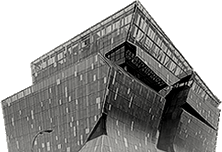
The design of the MCC reflects a desire to avoid a typical fortress-like solution and an ideology of fear, in an area considered dangerous, providing instead the community with a building that conveys a sense of transparency in every way.
Located in the Melrose Houses site, at the intersection of Morris Avenue and 156th Street in the South Bronx, the center serves the communities of the Jackson, Melrose, and Morrisania Houses, thus the diagonal orientation of the plan, relates to the Morrisania while the entry space, parallel to 156th Street opens the building to the Jackson Houses.
The gymnasium, with its elliptical configuration holds the otherwise very open corner while it presents a strong dynamic image when seen from the road. The Gym volume is connected to a bar-like building which contains the remainder of activities, administrative or educational, through a common entrance space; in this way the use is compartmentalized relative to scheduling and security.
Curtain wall glazing along the length of the bar exposes the interior to public view in both directions. Within the bar building, glass walls divide the classrooms from the double height transparent circulation area.