The Guggenheim Helsinki
This slideshow is part of: Michael Young
Helsinki, Finland
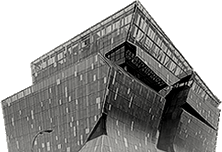
The exterior mass of the Guggenheim Helsinki proposal is a collection of objects. These objects have a simple plan geometry that transforms from a pure circle to a pure square. But in elevation these geometries are secondary to the strange figuration that occurs. Pragmatically the downward protrusions are structure, the upward protrusions are light scoops, but the aesthetics of the figures are unstable. These objects are either all heads with horns, or all headless bodies with odd truncated limbs, or all body-less butts, butted up against each other. The collected building figuration is formed through 14 similar but unique figures huddled together. The structural legs meet the site in a completely symmetrical organization, thus the moment of the most disparate fragmentation is held together by a collective rational. As the figures rise up to congeal into the main gallery floor, each figure begins to wiggle disturbing the overall symmetry while becoming side gallery spaces.
Entry takes place through the legs and under the belly of the collected mass in an open court similar to a shipyard drydock. A material transformation occurs on the figure’s surfaces as one walks under the building. The concrete structure is clad in recycled wood in various stages of decay collected from across the country of Finland. The exterior of the building is thus under constant renovation and transformation. This deteriorating material is applied in an ornamental pattern creating a tension between the form’s geometry and their sensuous qualities along the edges the pattern draws relations between the different figures, but by the time these motifs reach the underbelly they are almost symmetrical again, alluding inappropriately in a major cultural institution. The museum may collect, preserve and display art, but this design proposes an external presence as a collection of objects which in turn collect, reuse and display the material reality of rotting wood.