Bauhaus Museum Dessau
This slideshow is part of: Michael Young
Dessau, Germany
It would be a reduction of the complexity of the Bauhaus to divide it cleanly into a technical side and an expressive side, yet technical and expressive factors were often in conflict and in conversation throughout its history. The tension between these two motivations—and specifically the shape that tension took at the Bauhaus—continues to influence art, architecture, and design today. Our design of a museum for the Bauhaus Dessau is strongly informed by such productive tension—in this case, the tension between a desire for a modular repeatable system of organization, provided by a grid, and the exploration of sensation found in color and material experimentation.
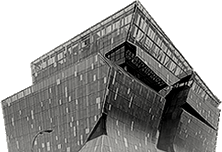
Our proposal for the Bauhaus Museum Dessau acknowledges these tensions through the design of a building as a collection of individual masses aggregated serially through a grid. We are calling these objects “vessels” as they allude to the crafted object of a vase or volumetric container. The vessels hover above the site on trunk-like legs, creating a light touch in the park and allowing passage underneath. The bellies of the vessels swell to touch each other creating an open continuous floor plan that connects the entire museum with a single floor. These combinations allow the building to fluctuate character between a huddle of singular objects, a sinuous coil of continuity, and a matrix of gridded repetition. Each attitude is at odds with the others, a productive tension resonating through the design.