Making Connections with Summer STEM
POSTED ON: July 13, 2026
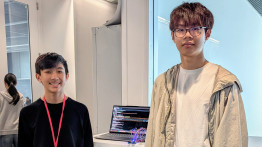
Christian and Lucas, two high school students participating in the 2026 Summer STEM program.
With the 2026 session of The Cooper Union’s Summer STEM program underway, high school students are moving beyond basic coding to develop connected systems that respond to the world around them. In the program’s Arduino and ESP32 Innovation Lab, students learn to work with microcontrollers—programmable devices that function like tiny computers—to create wirelessly connected sensor systems, smart technologies, Internet of Things (IoT) prototypes, robotic applications, and more.
Christian, a rising high school sophomore, and Lucas, a rising high school junior, co-designed a sound matching game during their first week of the program. Their device emits an audio frequency that players then try to match by turning a potentiometer and clicking a button once it reaches the corresponding pitch.
Watch Christian demo the prototype frequency matching game here.
“These high school students are engaging with the same connected computing platform and embedded systems that are often used for undergraduate-level coursework in computer science, electrical engineering, and computer engineering,” says Yvonne Thevenot, director of STEM Outreach at The Cooper Union. “They’re learning how software and hardware work together to sense information, communicate wirelessly, control devices, and transform ideas into functioning prototypes.”
Students in the Innovation Lab start with rapid prototyping using the Arduino Uno, an open-source microcontroller board. Later in the summer session, the students will advance to working with the powerful Espressif Systems 32-bit (ESP32) microcontroller to explore hardware and software systems connected via Bluetooth and Wi-Fi.
In addition to teaching high schoolers about engineering and computing fundamentals, Summer STEM provides important hands-on experiences for the Cooper undergraduates who serve as instructors for the program, all of whom are rising second-year students. “The courses create a layered learning experience,” Thevenot explains. “High-school participants gain early access to sophisticated technology and college-level concepts, while Cooper undergraduates develop their own skills as engineers, mentors, and educators.”
Exceptionally, this session’s Innovation Lab is led by a rising high school senior, Favor Brunner, who attends Poly Prep Country Day School in Brooklyn and learned how to program microcontrollers when he was just seven years old.
The Summer STEM program will culminate on August 13 with its second annual “Life’s a Pitch” competition, and event organized in partnership with The Cooper Union’s Maroon and Gold Labs and Cooper’s National Society of Black Engineers alumni. Students will present their prototypes to judges and compete for seed funding provided by the Summer STEM program, including $1,500 for first place and $750 for second and third places.