Cooper Union Summer STEM 2026
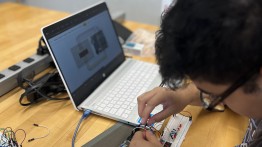
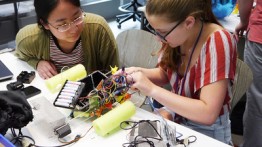
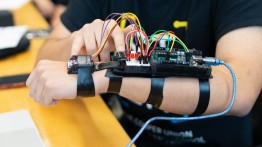
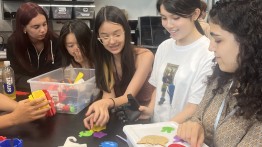
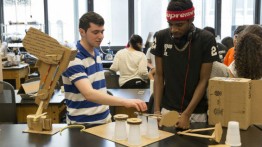
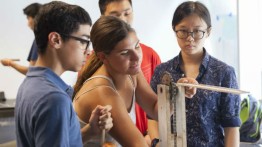
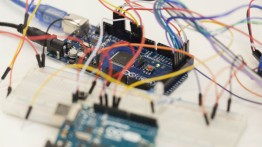
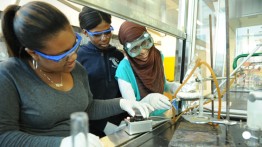
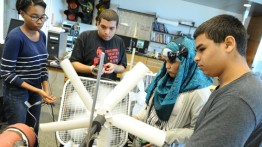
Students in a chemistry lab as part of the Summer STEM program. Photo by Chris Taggart/Cooper Union
Applications for Summer STEM 2027 will launch on December 11, 2026.
Summer STEM is an opportunity to try engineering and computer science for the first time or to dive deeper into engineering and computer science teamwork. Each 3- or 6-week class covers college-level topics and activities completed by Cooper Union undergraduates in their first or second year, or explores student and faculty research projects. Current high school students who have completed their 9th, 10th, and 11th grade years are eligible to apply. Students who are currently in the 8th grade and are considered rising 9th graders over the summer are not eligible to apply.
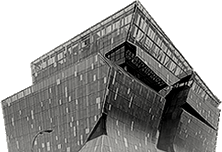
This highly selective program encourages all curious, compassionate, and college-interested students to apply, regardless of prior experience. Summer STEM 2026 occurs July 6 - August 13, 2026, Monday-Thursday, 9:00 am-3:00 pm. All of our classes will be held in person in our School of Engineering, located at 41 Cooper Square, New York, New York. Our Summer STEM program is open to high school students from all over the world; however, we do not provide housing. Financial aid is available to those who qualify. (Priority consideration is given to students who reside in New York City and its boroughs.) See our FAQs for more information.
Below are the Summer STEM 2026 courses that were offered:
SUMMER STEM 2026 COURSE DESCRIPTIONS
3-Week Courses
Session I: July 6 - July 23, 2026
Session II: July 27 - August 13, 2026
Cost: $3,150 (Financial aid is available to those who qualify - see our FAQs for information.)
- Design and Drawing for Engineering (Course is offered in both sessions. You choose 1 session.)
-
Students who have completed their 9th, 10th, and 11th-grade are invited to apply to this course; however those who have completed their 9th grade year will receive priority consideration for enrollment:
In this immersive three-week studio course, you dive into the world of engineering design through hands-on creation, rapid prototyping, and digital modeling. No prior experience needed—just curiosity and imagination. You will explore the engineering design process, learn user-centered design strategies, and build real solutions to real problems. Through sketching, technical drawing, and 3D modeling in OnShape, they'll bring their ideas to life and fabricate custom projects using 3D printers. The course also introduces basic circuits and electronic components to expand creative possibilities. By the end, you will design a unique project, prototype it, and build a portfolio that showcases how you think, design, and engineer a better world.
By the end of the course, you'll:
- Apply the engineering design process to identify probems and develop solutions.
- Create accurate sketches and technical drawings for engineering concepts.
- Build 3D CAD models using OnShape and fabricate prototypes with 3D printers.
- Demonstrate foundational knowledge of circuits and electronic components.
- Use user-centered design methods to create practical, meaningful products.
- Communicate their engineering thinking through a polished design portfolio.
- Practice entrepreneurship by framing their designs for real-world impact.
Course Instructor: Austin Wong, Alumnus, The Cooper Union (click the name for more information about this instructor)
- How To Build A Calculator (and More!): Intro to Digital Systems (Session I only)
-
Students who have completed their 10th and 11th-grade will receive priority consideration for enrollment:
When you run a piece of code on your computer to do a mathematical calculation, have you ever wondered how the machine actually spits out the answer? This course will introduce you to the foundations of howthe hardware in modern computers is designed to do arithmetic. You will explore the mathematical theory that underpins digital systems and will apply this knowledge to designing and prototyping digital circuits on breadboards. Project work will include designing and building the logic for a simple vending machine, a simple calculator, and much more.
By the end of the course, you'll:
- Achieve an extension of your mathematics knowledge (Boolean algebra, binary representation of numbers, binary arithmetic).
- Gain knowledge and hands-on application of Circuit Theory - Ohm's Law, transistors, logic gate design.
- Gain knowledge in Digital System theory - combinational logic, sequential logic.
- Participate in hands-on applications of basic circuit prototyping - using breadboards, multimeters, logic gates, switches, seven-segment displays.
- Gain experience with implementing projects that utilize debugging strategies incorporated with team collaboration.
Course Instructor: Dr. Michael Kumaresan, Adjunct Professor of Mathematics, The Cooper Union(click the name for more information about this instructor)
- Water Quality Engineering: Chemistry Meets Engineering (Session I only)
-
What if one morning there was no water? No shower, no drinking, no brushing your teeth—how would you survive? In Water Quality Engineering, which is the study of how to protect and maintain water quality, you'll explore the chemistry and engineering that keep our taps flowing and cities running.
In this course, you will uncover the science and engineering that help prevent such crises. As our world continues to evolve, the importance of clean water to our ever-growing demands cannot be overstated. In the United States, total water use is estimated to be roughly 350 billion gallons per day. This course will address these needs by exploring the strategies that engineers have developed to ensure clean water supplies for the built environment.
Topics will include conventional treatment processes – such as flocculation, sedimentation, and filtration – as well as emerging approaches to tackle new challenges (e.g., critical minerals, PFAS, and other emerging pollutants). You will work in small teams and participate in a wide variety of hands-on activities, including laboratory experiments and testing modules that simulate full-scale treatment systems (including the ones used in NYC), the design and assembly of DIY treatment units, and field-based assessments modeling real stormwater runoff – one of NYC's significant infrastructure challenges.
Overall, this course aims to provide you with a comprehensive experience and understanding of water treatment and to offer early exposure to the skill sets needed to advance a more sustainable future.
By the end of the Course, you'll:
- Describe the key steps in water and wastewater treatment
- Measure and interpret key water quality parameters using standard analytical methods
- Apply core engineering principles to develop treatment processes
- Understand how engineers address real-world challenges through collaborative and interdisciplinary problem-solving
Prerequisites:
- Substantial achievement in mathematics and chemistry is required: you must have received grades in mathematics and chemistry (any level - College, General, IB, AP) that are in the 93rd percentile and above to be eligible to apply.
- Those who have completed their junior year are eligible to apply to this course.
***Limited Enrollment: This class will be conducted in a laboratory; therefore, only 8–10 students will be admitted to ensure hands-on guidance and effective teamwork.
Course Instructor: Dr. David Kim, Assistant Professor of Civil Engineering (click the name for more information about this instructor).
- Quantum Theory of Gases: Aspects and Applications (Session II only)
-
NOTE: This course is a HYBRID COURSE, meaning students will be enrolled in this course online, as well as in-person at The Cooper Union. You have the freedom to choose (online or in-person) how you wish to participate in the course.
Physics, or natural philosophy, is the science which encompasses all others. Physics explains both the microscopic and macroscopic, and as such, concerns itself with systems smaller than atoms and larger than galaxies.
The Context for This Course
Gases are the ideal platform for explaining both the microscopic and macroscopic scales, and thus, this 3-week course will focus on the development of tools quantum physicists use to model gases.About the Course
The experience is lecture heavy, supported by structured problem-solving, check-ins, and culminating in a final Python project. You’ll learn ideas and modeling strategies used to describe gases.This course is designed for students who already have experience with Calculus and are ready to move quickly through advanced material.
If your goal is to gain an introductory understanding of Calculus in preparation for a future class, we recommend taking a foundational course first. Choosing the right course now can help set you up for success later. Needing more preparation is completely normal, and there are many great pathways into advanced math. Taking time to build your foundation first can help you feel more confident and prepared in future courses like this.
Prerequisites
- Completion of Pre-Calculus and can demonstrate proficiency.
- Completion of a Calculus or an advanced math course is strongly recommended.
- You must be proficient with algebraic manipulation, functions/graphs, and multi-step problem solving (i.e. you received an "A" or an equivalent grade if your school uses numbers for grades).
- If you have Prior Python experience, it is helpful but not required – you will receive starter code and guided support to ramp up.
By the end of the course, you will have:
- A working Python simulation of an ideal gas and visualize system behavior.
- The ability to explain how microscopic particle behavior connects to macroscopic quantities.
- Applied modeling ideas and approximation strategies to gases.
- Analyzed and communicated findings using plots, in addition to short scientific explanations.
Course Instructor: Abdula Ali, 4EE/MEng, The Cooper Union; Harvard University Ph.D. student (click the name for more information about this instructor).
6-Week Courses
July 6 - August 13, 2026
Cost: $5,150 (Financial Aid is available to those who qualify - see our FAQs for more information.)
Students who have completed their 9th, 10th, and 11th-grade are invited to apply to these courses:
- Circular Design: Engineering Sustainability for a Greener Future
-
As the world's population grows, the need to advance civilization while preserving the quality of life becomes increasingly urgent. With finite resources being depleted at unsustainable rates, this course challenges you to explore sustainable practices in product design and development. Through hands-on projects and real-world applications, you will investigate renewable energy technologies, innovative strategies to repurpose waste materials, and methods to assess environmental footprint using Life Cycle Assessment (LCA). By integrating concepts from chemical, mechanical, electrical, and civil engineering, you will gain a comprehensive perspective on sustainability. They will study the circular economy, a model that minimizes waste by keeping materials in use for as long as possible, and analyze case studies to examine how these principles are applied in consumer products and infrastructure systems. Combining creativity and problem-solving, you will design functional products and 3D-printing prototypes that address real-world environmental challenges, equipping you with the skills to innovate toward a more sustainable future.
By the end of the course, you'll:
- Understand the fundamentals of sustainability, renewable energy technologies, and the circular economy
- Apply innovative techniques to repurpose waste materials, such as plastics, into functional and practical products
- Utilize LCA tools to analyze and minimize the environmental impact of products and systems
- Collaborate effectively in teams to design and prototype solutions that address real-world environmental challenges
- Strengthen problem-solving, creative thinking, and communication skills through hands-on projects, data analysis, and professional presentations
Course Instructor: Dr. Hejintao Huang, Assistant Professor of Civil Engineering, The Cooper Union (click the name for more information about this instructor).
- App Lab: Create Your Own iOS Apps with Swift: From idea to app — build, code, and launch your own iOS masterpiece in 6 weeks!
-
Got a great app idea? Turn it into reality with App Lab, a hands-on 6-week journey into iOS app development using Swift, the language behind your favorite apps! You'll start with the basics of coding and quickly move to building interactive apps, designing sleek interfaces, and prototyping your own original app. No prior programming experience? No problem — we'll guide you step by step, with fun projects and real-world tools.
What You'll Learn & Do:
- Swift Programming Essentials: Variables, constants, loops, functions, and control flow — all in a playful, interactive way.
- iOS Development Tools: Explore Xcode, use the iOS Simulator, debug your code, and bring your apps to life.
- App Design & UI: Use UI Kit, Auto Layout, and Stack Views to craft smooth, professional interfaces.
- Hands-On Projects:
- Mini apps to master Swift fundamentals
- Data display apps to organize and showcase user input
- Personality quiz apps for fun, interactive experiences
- Code your very own original app prototype — ready to demo!
By the end of the course, you'll:
- Code confidently in Swift
- Design and prototype fully functional iOS apps
- Understand the path to publishing your app on the App Store
- Be ready to take your first steps as a tech creator
Course Instructor: Maria Bernal, Swift Guru (click the name for more information about this instructor).
- Digital Fabrication for Human-Centered Innovation
-
In this hands-on studio class, participants will explore how art, design thinking and engineering intersect through 3D modeling, 3D printing, wearable technology, and microcontroller-based electronics (like Arduino). You will learn core skills in digital modeling, rapid prototyping, circuit building, and basic microcontroller programming.
Throughout the course, you are encouraged to design with purpose—investigating how interactive objects and wearables can support humanitarian needs, improve accessibility, or assist individuals with physical or cognitive differences. Projects may include custom electronic gadgets, wearable tech, or assistive devices tailored to specific users.
By the end of this course, you will be able to:
- Use 3D modeling tools to design digital prototypes for interactive objects and wearable technology.
- Operate 3D printers and rapid-prototyping tools to transform digital models into physical products.
- Build and troubleshoot electronic circuits, including integrating sensors, LEDs, and basic components.
- Program microcontrollers (such as Arduino) to bring interactive objects and wearables to life.
- Apply human-centered design principles to create purposeful projects that address real-world needs.
- Develop assistive, accessible, or humanitarian-focused devices tailored to the needs of specific users.
- Collaborate in a studio environment, from brainstorming and iterative design to fabrication and presentation.
- Communicate design decisions effectively by using documentation, sketches, and demonstrations to share the creative process.
Course Instructor: Josh Rothman, Technology Teacher and Integrator (click the name for more information about this instructor).
- Algorithms of the Future: Hack, Code, Create: Build the Future with HTML, CSS, JavaScript, Python & React.js
-
Get ready to code your way to real-world impact! In this six-week, hands-on course, you'll dive into HTML/CSS, JavaScript, Python, and React.js while exploring how technology shapes society and drives environmental justice. Through a guided mini-hackathon, you'll team up to design, code, and prototype projects that tackle real challenges—all while gaining insider knowledge from engineers at Google and top NYC AI labs.
No prior experience? No problem. By the end of the course, you'll have built future-focused projects that show what it means to be a tech creator for good.
What You'll Do:
- Code real projects in HTML/CSS, JavaScript, Python, and React.js
- Build tech solutions for climate & social impact
- Collaborate in a mini-hackathon to turn ideas into prototypes
- Pitch your projects to peers and industry experts
- Learn from top engineers at Google and NYC AI labs
- Think critically about tech's impact on society and the environment
Why Take This Course?
You'll leave with hands-on coding skills, a portfolio of projects, and the confidence to create tech for good—all in a fast-paced, fun, mini-hackathon environment.
By the end of this course, you will:
- Understand how AI shapes our world
- Gain a clear, youth-friendly understanding of the social, ethical, and environmental impacts of AI systems.
- Build industry-level coding skills—no experience needed
- Learn foundational programming through hands-on activities and a guided mini-hackathon.
- Design tech solutions for environmental justice
- Explore how technology can support climate action and create more sustainable, equitable communities.
- Create future-focused prototypes
- Collaborate in teams to build innovative concepts and prototypes that imagine a fairer technological future.
- Connect with real industry innovators
- Meet engineers and researchers from Google and leading NYC AI labs, and gain insight into cutting-edge work underway today.
- Think critically and ethically about technology
- Develop the ability to question, analyze, and reimagine the role of AI in society.
- Strengthen teamwork and communication skills
- Work in groups, pitch ideas, and present projects with confidence.
- Grow as emerging creators and problem-solvers
- Build confidence as budding technologists ready to use tech for good.
Course Instructor: George Hofstetter, Founding CEO, GHTech, Inc. (click the name for more information about this instructor).
- Python for Engineers: Discover. Code. Innovate.
-
Jump into the world of engineering problem-solving with Python for Engineers, a fast-paced six-week journey into scientific computing and data exploration. You'll start by mastering Python fundamentals through hands-on tutorials and mini game-design challenges that make learning to code both intuitive and fun. From there, you'll dive into the power of scientific computing—using numerical methods to tackle real engineering and physics problems.
Next, you'll explore the city through data. Using open-source datasets about New York City, you'll learn how data scientists clean, analyze, and visualize information to uncover insights. Along the way, you'll develop eye-catching graphics, strengthen your math and coding toolkit, and collaborate on creative challenges.
By the end, you'll build a final project that showcases your Python skills, engineering curiosity, and data storytelling abilities.
By the end of this course, you will:
- Become proficient in Python and the data science stack
- Build mathematics and coding skills for scientific computation
- Explore datasets consisting of a variety of data types
- Communicate effectively through data visualization and graphic design
- Develop presentation, teamwork, and problem-solving skills
Course Instructor: Matt Grattan, Alumnus, The Cooper Union, Adjunct Lecturer of Mathematics, CUNY's New York City College of Technology (click the name for more information about this instructor).
- Arduino & ESP32 Innovation Lab: From Circuits to Smart Devices: Turn Your Ideas into Real-World Prototypes
-
Starting with rapid prototyping on the Arduino Uno and gradually advancing to connected systems on the ESP32 (Espressif Systems 32-bit microcontroller), you explore the full spectrum of modern embedded innovation. The course begins with hands-on immersion into microcontroller fundamentals, teaching you how hardware responds to digital inputs and outputs, pulse-width modulation, analog sensing, and simple actuators. You will experiment with "vibe coding," an intuitive, exploratory approach that accelerates creative problem-solving and allows ideas to be prototyped quickly.
As confidence in Arduino-based systems grows, the class transitions to applied engineering with the ESP32, introducing wireless capabilities such as Wi-Fi and Bluetooth for real-world Internet of Things (IoT) designs. You interact with displays, environmental sensors, and smart actuators to create devices that collect data, communicate information, or respond intelligently to their environment.
Alongside electronics and programming, you will learn to design functional 3D housings in a computer-aided design (CAD) tool and prepare parts for 3D printing, enabling them to package electronics into polished, testable prototypes. Throughout the course, you practice engineering design thinking: identifying problems, brainstorming solutions, iterating ideas, and clearly communicating the process.
By the final week, student pairs propose and implement an original hardware-software system, culminating in a showcase where teams present their prototype, explain their design process, and demonstrate real-world impact.
***Prerequisites: Prior programming experience in any language is recommended so that class time can focus on microcontroller implementation, debugging, and project development rather than introductory coding fundamentals. Experience developing code solely using artificial intelligence (AI) tools, block-based coding platforms, or code generators does not count as prior programming experience. If you have only used these latter tools, you are advised not to enroll in this course.
By the end of this course, you will:
- Develop familiarity with embedded systems tools, sensors, actuators, and microcontroller workflows.
- Apply intermediate programming techniques using C++ within the Arduino and ESP32A (Espressif Systems 32-bit microcontroller) frameworks.
- Interface hardware devices correctly, interpret sensor data, and use debugging strategies to troubleshoot software and electronics.
- Use a computer-aided design (CAD) tool to model, refine, and prepare 3D housings that support functional robotics designs.
- Apply engineering design thinking to identify problems, brainstorm solutions, and build iterative prototypes.
- Communicate technical ideas effectively through presentations, diagrams, demonstrations, and code walkthroughs in clear, jargon-free language.
- Design and implement an original hardware-software prototype demonstrating creativity, technical skill, and sound engineering reasoning.
Course Instructor: Favor Brunner, Mechatronics/Robotics Student Engineer, Poly Prep Country Day School
Still Have Questions? |
Read the STEM Program FAQs to learn more about Summer STEM 2026
Hear about Summer STEM from past students and staff: What is Summer STEM? Video.
To receive updates on our upcoming programs, please complete our interest form.
Still have questions about SUMMER STEM? Email stem@cooper.edu