Atina Grossmann Retires After 30 Years
POSTED ON: May 26, 2026
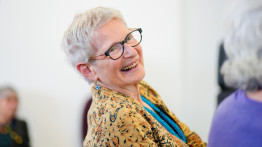
Photo by Michelle Biagi A’23
Professor Atina Grossmann has spent three decades teaching Cooper Union students to relate the most difficult questions of history to the urgency of political life. Now, at the end of the 2025–26 academic year, she is retiring from her full-time appointment as Distinguished Professor of History in the Faculty of Humanities and Social Sciences (HSS). In recognition of her contributions to her field and to the institution, she will be appointed Professor Emerita at this year’s Commencement ceremony.
Grossmann’s accomplished career has traversed the lines of activism and scholarship across women’s history, migration studies, and modern German and diasporic Jewish history. Since joining Cooper in 1996, she has helped shape the HSS classroom into a space where architecture, art, and engineering students alike learn to historicize problems and contest reductive histories.
As a leading scholar, Grossmann has been recognized internationally with honors such as the 2024 Moses Mendelssohn Award, bestowed by the Leo Baeck Institute, and fellowships and appointments at institutions including the United States Holocaust Memorial Museum, the Friedrich Schiller University Jena, Humboldt University Berlin, and the University of Haifa. Her book Jews, Germans, and Allies: Close Encounters in Occupied Germany received both the George L. Mosse Prize of the American Historical Association and the Fraenkel Prize in Contemporary History from the Wiener Holocaust Library. She’s also published extensively on women’s history in interwar Germany, including her landmark study Reforming Sex: Birth Control and Abortion Reform in Germany. She is a co-editor of the volume The Surviving Remnant: Documents on Jewish Displaced Persons in Postwar Germany 1945-1950 (with A. Kramen, A Patt, T. Lewinsky, 2024). Her current research explores entanglements of family memoir and historical scholarship, tracing stories of Jewish refugees from National Socialism in Iran and India.
Through her teaching, Grossmann has challenged generations of students to read critically and to question idealized narratives of the past. In the third semester of the HSS core curriculum, a course Grossmann influenced heavily over the years, students study the formation of modern society from a global perspective, beginning with the Industrial and French Revolutions. Her expertise in the recurrent crises of democracy—war and genocide, displacement and migration, inequality and political repression—often places her teaching in direct dialogue with students’ own experiences of activism and social practices. She’s taught courses on modern Europe, Fascism and National Socialism, the Holocaust, refugees and migration, and gender and sexuality.
Grossmann recently reflected on teaching amid times of crisis in a conversation with Kit Nicholls, director of the Center for Writing and Learning. The interview, which will be released as a podcast episode for the Center for Writing and Learning Journal, also looks back at Grossmann’s own coming-of-age, tracing her path from growing up in postwar New York in a family of Jewish refugees from Nazi Germany, through the social upheavals and New Left movement of the late 1960s and 1970s, to pioneering the field of women’s history as a graduate student at Rutgers University.
“I think the important lesson was that it was possible and satisfying to integrate a political life with the life of the mind,” Grossmann told Nicholls. “I didn’t have to separate my intellectual interests and my political concerns.”
Among many remarkable stories about her political education, Grossmann recounts winning an award for her fifth-grade essay about a child in the Warsaw Ghetto, being expelled from the University of Chicago for participating in campus occupations, and reading a heavily redacted FBI file on herself. The conversation also turned to the state of the classroom today.
Grossmann’s final course as a full-time faculty member at Cooper was a Spring 2026 seminar titled Decolonization, Nation Building, and Displacement, co-taught with Ninad Pandit, assistant professor of history. Focusing on the period of 1947–48, it examined the violence, displacement, and questions about national belonging that followed the redrawing of political boundaries, including the British partition of colonial India and the United Nations plan for the partition of Mandatory Palestine.
She rejects the notion that teaching students to understand history can be abstracted from the problems and divides of the current political moment. Referencing an elective she offered in Fall 2025 that examined the meaning and resonances of fascism in the 20th century and today, Grossmann said, “I think that it's objectively insane to teach a class on fascism and to pretend that we are engaged in an inquiry motivated by wanting to better understand what's going on, but where actually making those links and speaking about them and bringing them up is inappropriate.”
Throughout her years at The Cooper Union, Grossmann has inspired countless students and colleagues to learn from past failures of democracy and to ask how we can overcome them together in the present. Though she’s stepping away from full-time teaching, Grossmann expects the classroom will draw her back to Cooper for elective offerings in future semesters.
The full podcast interview with Atina Grossman will be released in the fall as part of the second issue of the Center for Writing and Learning Journal.