Romain du Roi: 330 Years Later
Monday, December 8, 2025, 12:30 - 2:30pm
Add to Calendar
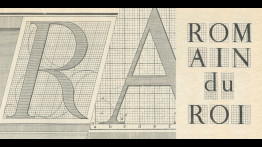
According to various accounts, the first trial cuts of what became the first of the Romain du Roi (King’s Roman) fonts were made 330 years ago in 1695. To acknowledge this date we are taking a closer look at the history and legacy of this ambitious royal type project which took some 65 years to complete. As part of the Herb Lubalin Lecture Series, Dr. Sarah Grandin and Riccardo Olocco will address various misconceptions, and some of the lesser-known details behind the making of the typefaces for the exclusive use by the Imprimerie Royale. The presentations will provide the audience with the wider context of why this large scale typeface design project was initiated and touch on the technical process of making of the punches. The talks will also highlight the complex relationship between the various stake-holders and the artisans entrusted to make the letterforms.
Registration is required here.
Dr. Sarah Grandin is lecturer in the Arts of Early Modern France at the Courtauld Institute of Art. She specializes in seventeenth- and eighteenth-century French visual and material culture. Prior to joining the Courtauld, she was a postdoctoral researcher at the Clark Art Institute. She served as the Lunde Fellow and as the Clark-Getty Paper Project Curatorial Fellow, in which capacity she co-curated the exhibition Promenades on Paper: Eighteenth-Century French Drawings from the Bibliothèque nationale de France and was co-editor of the accompanying catalogue. Her first monograph, titled To Scale: Manufacturing Grandeur in the Age of Louis XIV, is in preparation. Throughout her research, she investigates the relationship between making and knowing, particularly in the artisanal realm. She has published on drawing, typography, Savonnerie carpets, intaglio prints, and scientific illustration.
Designer and researcher Riccardo Olocco is currently a visiting research fellow at the University of Reading where he completed his Ph.D., titled "A new method of analyzing printed type: the case of 15th-century Venetian romans." Previously he lectured in typography at the University of Bolzano, and freelanced as a type and graphic designer in northern Italy. Olocco publishes articles and lectures across Europe, and is a board member of the Nebiolo History Project as well as a member and co-founder of CAST, Cooperativa Anonima Servizi Tipografici.