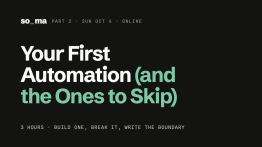
Your First Automation (and the Ones to Skip)
Cost: $270.00
1 online session
Sunday, October 4
10:00 am–4:00 pm
PREREQUISITE FOR THIS COURSE:
You will need to have taken Get AI Out of Your Head (and Into Your Process), AKA Part 1, or have an equivalent process map that you can bring with you to continue to this workshop.
This workshop begins from a completed Enablement Matrix — a mapped process with each step marked automate, draft-with-review, or stays-human. If you didn't attend Part 1, you must arrive with your own written breakdown of one real process and the steps you believe AI could take on; there is no time in Part 2 to build that map from scratch. Part 1 is the recommended route.
You have a map and a candidate step. Now the harder question: should you actually automate it — and if so, how do you build something that survives a real week of work?
This workshop is Part 2, the build session. You take one step from your matrix, turn it into a working instruction with the context and examples it needs, run it against real (non-confidential) inputs, and find out where it breaks. Then you write the boundary: what it will never be allowed to do, who checks its output, and how you'd know if it started going wrong. You leave with one automation ready to pilot and a clear-eyed list of the ones to skip.
How it's taught.
Build-and-break, in short cycles: you draft, you test in Gemini against your own material, you swap with a partner who tries to break it, you revise. Two short demos frame the session — one on giving an instruction the context it needs, one on catching failure early. The final hour is the part most people never do: writing the boundary and the check, then a group round where each person names the automation they're not going to build, and why.
There are four Learning goals.
One working automation.
A tested instruction for a real step in your process, complete with the context, examples and format it needs — ready to pilot on Monday.
A failure map.
Hands-on knowledge of how your automation breaks — found deliberately in class, by a partner trying to break it, rather than by a client later.
A written boundary and check.
One page stating what this automation will never do, who reviews its output, and the signal that means switch it off — the document that makes colleagues and clients comfortable.
A skip list, with reasons.
The steps you deliberately won't automate and why — the judgment that separates a professional from an enthusiast, and the part your team will thank you for.
Professional benefit.
Most AI pilots fail quietly: something gets automated, nobody defines who checks it, quality slips, trust goes, and the tool is abandoned. This session teaches the discipline that prevents that — build small, test hard, write the boundary. You return to work with something running a nd the argument for why the rest is staying human, which is usually the more valuable half.
Prerequisites & level.
Part 1, or your own written process map as described above. No technical background needed; no code is written.
A free Google account is required for the in-class Gemini exercises.
Supply list
- Your Part 1 map (or equivalent)
- a laptop with a free Google account
- two or three real, non-confidential inputs your automation should handle — the messy ones are best
- pen and paper
- Zoom and a stable connection. Nothing to buy.
This class is limited to 14 students. There will be a one hour break.
Course Code: AU1026
Instructor(s): Subalekha Udayasankar