Iman Raad
Adjunct Professor
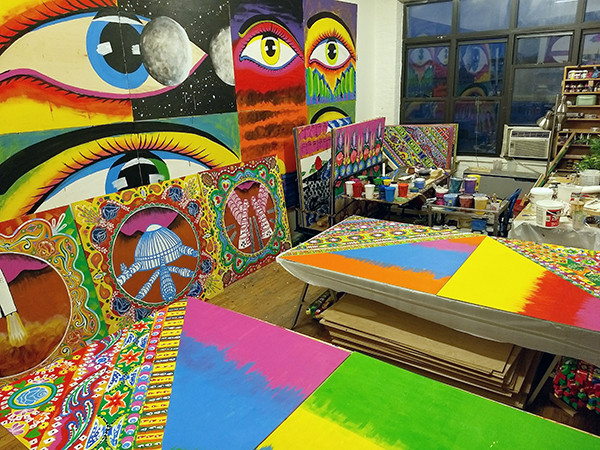
Iman Raad works across a variety of media, including painting, drawing, printmaking, embroidery, and graphic design. His work has been featured in several design books including The Phaidon archive of five hundred designs that matter and his art practice acknowledged in a variety of media including The New York Times, Artspace and art21. Recent exhibitions include A Third Language at the Queensland Art Gallery, Brisbane, Australia (2023), the 58th Carnegie International at the Carnegie Museum of Art, Pittsburgh (2022), Reflections: contemporary art of the Middle East and North Africa at the British Museum, London, UK (2021), Contemporary Art from Asia, Australia and the Pacific at the Centro Cultural La Moneda, Santiago, Chile (2019), the 9th Asia Pacific Triennial of Contem-porary Art at QAGOMA, Brisbane, Australia (2018), Standing Still, Lying Down, As If at the Museum of Contemporary Art Detroit (MOCAD) (2018), and The Flag Art Foundation in New York (2018).
Raad (b. 1979, Mashhad, Iran) holds an MFA in Painting and Printmaking from Yale University (2017) has taught at The Cooper Union School of Art, The Parsons School of Design, and Fordham University, and has been invited to deliver artist talks and visit students at institutions including Yale University School of Art, Princeton University, Northwestern University’s Department of Art, Rhode Island School of Design, and Pratt Institute.