Driven by Divergent Thinking
POSTED ON: July 30, 2025

Barbie movie pop-up shop at Bloomingdale’s department store.
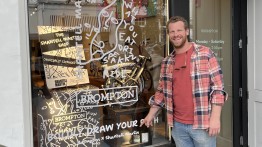
August Hunt A’17 stands beside Brompton Bicycle’s window display for a 2024 collaboration with Object Fabrication’s client, artist Shantell Martin.
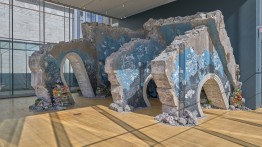
Firelei Báez, the vast ocean of all possibilities (19°36’16.9”N 72°13’07.0”W, 41°30’32.3”N 81°36’41.7”W), 2022.
Mixed media installation at the Cleveland Museum of Art.
This article appears in the Spring 2025 issue of At Cooper magazine.
August Hunt A’17, founder of Object Fabrication, is a proudly dyslexic business owner, although he’ll be the first to tell you he didn’t always feel this way about his learning disability. When Hunt was diagnosed with developmental dyslexia in second grade in Dallas, Texas, his parents were told it was unlikely he would be able to attend college and that they should consider enrolling him in a vocational school or signing him up for football.
Not only did he go on to college, but he was accepted to The Cooper Union, a member of the last class admitted before the institution began charging tuition. “What pushes me is that I was told ‘no’ a lot of the time, told I was dumb or stupid,” says Hunt, who studied sculpture and photography in the School of Art. “Being told ‘no’ meant just pushing myself harder and figuring out another way to do it.”
At Cooper, Hunt grew both as an artist and a leader. Participating in critique with faculty members and classmates gave him the language to present and defend his work, which in his career has translated into an ability to communicate effectively with team members and clients regarding projects. Hunt worked hard at school, both in his artistic pursuits and as a member of the soccer team, waking up at 5 am to practice. He says he and his classmates felt honored for the opportunity to study at Cooper for free and so were especially committed to their work.
Upon graduating in 2017, Hunt was hired at Saks Fifth Avenue, constructing window displays and custom fabrication projects that eventually took him to Art Basel. When the COVID-19 pandemic hit and Hunt was laid off in 2020, he redirected his energy to a side project, Object Fabrication, and quickly grew the business threefold from 2020 to 2021. In the years since, the shop has expanded to four times its initial footprint in East Williamsburg, Brooklyn, and Hunt has ambitions for continued growth.
Leading Object’s rapid rise requires perseverance, and owning his dyslexia has given Hunt an invaluable advantage as an entrepreneur. Hunt says, “I know I can’t do everything. To be a proud dyslexic was to figure out what my strengths and weaknesses were.” Those strengths include communication skills, spatial reasoning, and being able to solve creative problems on tight timelines. During high school, Hunt became involved with Eye to Eye, a nonprofit serving neurodivergent students. He credits that experience with teaching him to embrace his dyslexia as something that makes him unique. Nick Ducot, Object’s shop director, says Hunt has been a mentor to him despite being 10 years his junior. “He’s got a mind that works differently than most people I’ve met. He sees the bigger picture and reads people very well.”
Hunt’s dyslexic thinking not only shapes his own performance but also sets the tone for the work culture of the Object Fabrication shop. “His confidence is contagious,” Ducot says. Employees describe Object’s shop as a learning environment, where freelance contractors are encouraged to try their hand at new aspects of making—such as welders taking up carpentry, or painters trying product assembly—and Hunt has ample patience in teaching new skills. This inclusive environment welcomes neurodivergent employees and produces more innovative and experimental approaches to solving problems.
“A lot of times we’re telling people we can build something we’ve never built before,” Hunt says. Tactile solutions may come easily to a big-picture thinker like Hunt, but it’s only by embracing his dyslexia, and with it his strong interpersonal skills, that he’s been able to build such a thriving community of makers. He sees Object’s contractors as a team of artists making work for other artists.
Hunt has innumerable stories to share of leveraging personal relationships to clinch big contracts, from trading a bottle of tequila for access to a neighbor’s forklift to convincing a landlord to rent him more shop space so that he could produce a large-scale art installation. In fact, the latter project was fabricated for a fellow Cooper Union graduate, artist Firelei Báez A’04, as part of a 2022 installation at the Cleveland Museum of Art. In a hyper-digital world, Hunt sees the value of maintaining human connections and face-to-face interactions.
Much of Hunt’s own creative practice while he was a student at Cooper explored ideas of permanence, a theme that bears relevance to his work today. By refusing to pigeonhole its manufacturing abilities and instead treating each new challenge as a growth opportunity, Object Fabrication’s business ethos is intentional about seizing on the impermanence of the fabrication industry. This flexibility has landed contracts with a range of clients including Patrón Tequila, Venmo, TikTok, Adanola, Bloomingdale’s (for a Barbie takeover), Moxy Hotels, and even Elton John. Ducot says, “We’re developing skills to provide different capabilities: sculptural to structural to art fabrication. That keeps us on the cutting edge of our artistry.”
Hunt aspires to grow Object to the point that he will be able to return to creating his own large-scale artworks in the shop space, right alongside his clients’ one-of-a-kind fabrication projects. He encourages other budding entrepreneurs with learning disabilities or differences not to be afraid to take risks. “Don’t take a ‘no’ as you can’t do it. Do it in a different way, do it bigger.”