ZHENIA DEMENTYEVA AR'21
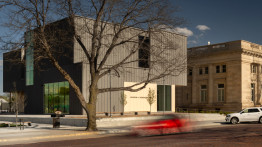
Zhenia Dementyeva has degrees in architecture and engineering, but the best word to describe her work might simply be “translator.”
As a client representative at MAASS, an architectural consulting firm founded by Cooper alumnus John Maass, she works with architects, builders, clients, engineers, and other consultants to make sure everyone’s objective is clearly communicated. “They don't all talk each other's language, but we're kind of the translator between all parties.”
MAASS’s focus is stewardship for mission-driven clients doing capital projects. That includes museums, theaters, and galleries, as well as private owners committed to saving a building of cultural importance. (The firm is currently helping an owner restore a McKim, Mead, and White Newport “cottage.”)
A 2021 graduate of the Irwin S. Chanin School of Architecture, Dementyeva appreciated the rigor of the program and the opportunities to break rules. She recalls taking Descriptive Geometry with Professor James Lowder, who let students resolve problems using untried techniques, but only if they had a very good reason and could execute the alternative well. That approach has directly informed her professional life.
“Architecture is one of those industries that's been around for a long time, and I think there's a little bit of an attitude of ‘things are working, so why change them?’” she said recently. But she feels it’s always worthwhile to explore the reasons for any design or construction decision. “If there is something that is accepted by the industry, and we don't have a good explanation for why it is accepted as the status quo, that doesn't mean that we should be accepting it as one. I think there's a lot of opportunity for innovation, and that's what I'm really passionate about.”
Before MAASS, Dementyeva worked at numerous architecture firms including Pei Cobb Freed & Partners and interned at Diller Scofidio + Renfro. She spent a year in Copenhagen as a designer with Henning Larsen. Her experience exposed her to the frustration of value engineering and moments when architects could feel sidelined in project decisions.
That, plus Dementyeva’s interest in bridging the concerns of architecture and engineering, were starting to form at Cooper where she took courses outside of architecture such as computer science and data analysis. Last May, she completed a master’s degree in engineering from Carnegie Mellon’s Integrated Innovation Institute, a program that emphasizes cross-disciplinary communication in engineering, business, and design. That training has helped her understand and articulate the mechanics of how projects actually happen, including budgets, schedules, financial decisions, and construction.
It was a logical move for Dementyeva, who has found that her engineering knowledge helps her champion the design process while taking part in the technical decisions on a job, which can encompass everything from HVAC system details to the inner workings of a theater. An added bonus of the degree is she can communicate in a language that is respected by contractors, engineers, and other collaborators.
At MAASS, Dementyeva enjoys the firm’s flexibility and openness to new methods of working and of finding work: if an opportunity doesn't exist, she and her colleagues are willing to invent one. A case in point is their recent interest in new ways museums are approaching storage, namely by making the storage system part of an exhibition program.
To learn more, Dementyeva and the rest of the firm organized a weeklong European study trip involving about 20 people from seven museums, traveling from Edinburgh through England and France to Rotterdam. Participants came from a wide swath of the firm’s professional contacts. The trip, which allowed them to see museums at different stages of developing new collection-storage models, was one more way to rethink standard operating procedure, which is what drives her: “I'm kind of nerdy about tools and processes. I just want to make things better.”