SEDRICK CHISOM A'16
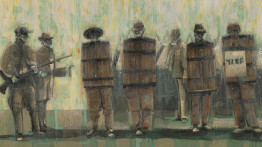
Sedrick Chisom’s complex, often unsettling paintings inhabit narrative worlds that seem to precede and exceed the canvas: worlds populated by figures whose histories are only partially available, and situations in which the viewer must determine what has happened, who is implicated, and where they themselves stand. They are haunting images, clearly influenced by Goya, of ghostly figures in otherworldly settings often portrayed in saturated colors muted by dark washes.
Chisom’s narratives emerge through a reciprocal process of writing and painting. A single painting once generated so many questions that he responded by writing a 60-page play set in the same world. The play answered some questions but produced many more. That feedback loop has remained central to his practice. And narratives are continually altered by the act of painting.
“So many things I’ll write will be based on there being a position of knowledge that exists but is elsewhere, inaccessible, or located in the other, and the character or narrator or world is distorted around that point,” he says. “So, writing for me is primarily subtractive because of this mode of omission, but new things are triggered into emergence from the failure of knowledge to transparently appear in the world.”
For Chisom, even failure can become a form of discovery. A brush may be too heavily loaded, a passage too slow, an attempt at description insufficiently articulated. Chisom believes that an error can disclose something unexpected and valid about the painted world—or about painting itself. The discovery forces him to abandon a preconceived intention and respond to what the work is becoming.
An apparent failure, he says, can disclose something true about the world he is painting—or about painting itself. That discovery can send the work in an entirely different direction.
“It’s not a failure in the painting,” he explains. Instead, it is a failure to reproduce an idea he’d started with. The painting, in other words, can know something he didn’t.
That willingness to follow the work wherever it leads is partly rooted in Chisom’s background in graphic design. Before studying painting at Cooper, he took many graphic design classes, an education that continues to shape the way he thinks about composition and surface.
Collage provided an early bridge between the two disciplines. Poster design also taught him to think about how an image changes depending on the distance from which it is viewed. Up close, a painting can reveal texture and material; from farther away, its larger structure has to hold together. His study of typography reinforced that sensitivity. At the Lubalin Center, he learned to examine typefaces not simply as carriers of information but as textures, considering how their visual qualities interacted with photographs and other elements.
He brought that same intensity of looking to painting. Chisom’s palettes can appear fluorescent, clashing, or almost unnatural. He finds inspiration in color combinations that seem “wrong” in everyday life: the accidental juxtapositions in children’s crayon drawings, industrial decay, or paint splattered across a studio floor. If a combination produces an uneasy reaction, he trusts that reaction is telling him something.
Working on unprimed, unstretched fabric, he repeatedly layers diluted and concentrated paint, sometimes allowing it to soak into the material and sometimes creating a surface for it to sit on. He introduces unexpected sequences of colors, then sands the entire surface with an orbital sander, exposing layers that had disappeared beneath newer ones. He repeats the process until the accumulated surface begins to feel like something beyond the sum of its individual decisions.
Chisom was born in Philadelphia in 1989, during a period marked by the violence surrounding the 1985 MOVE bombing. He is reluctant to describe a direct visual influence, comparing the event’s presence in his thinking to water surrounding a fish. What interests him more directly is how violence is represented: whose suffering is given individual identities and context, and whose is presented as anonymous, inevitable, or impersonal.
His paintings often depict Western Civil War subjects, but Chisom deliberately subjects them to representational strategies more commonly imposed on non-Western victims of violence. The choice shifts the viewer’s position and calls attention to the assumptions that govern sympathy and recognition. That is, how does a society decide whose violence is made legible and whose is allowed to disappear?