COOPERMADE Founders and Presidents


In honor of Presidents’ Day, we present just a few of the many Cooper alumni who’ve held the position of founder or president—whether for their own business or for a professional organization.
Dr. Charles Fan EE'95
Charles Fan, CEO and co-founder of MemVerge, started the company with his dissertation advisor at CalTech, Shuki Bruck. The two are banking on memory becoming the platform for all application data. The goal is to eliminate the transfers of data between memory and storage, thereby creating greater speed for applications.
In a 2020 interview, he said, “If we can imagine a world where memory is big enough, persistent enough, and reliable enough that it can hold all the data all the time, then you’d never need to move data anymore and do that unnecessary work.”
Fan, who was formerly the CTO and cofounder of Rainfinity, grew up in China and attended high school in Indiana before earning his bachelor’s degree in electrical engineering at The Cooper Union. He’s noted that despite all he’s learned through his many work experiences in technology, his time at Cooper was formative: “The four years in New York City were the most educational. I had the opportunity to be on my own and to socialize with a lot of different people, I worked on a lot of different things, and I was surrounded by a lot of different stimulating disruptions. Those were growing years for me.”
George Reeves ME’64
George Reeves and his business partner and wife, Ross Wisnewski, know better than most people the urgent need for innovative thinking to combat climate crisis. For 40 years they ran an energy consulting firm, George Reeves Associates. (Wisnewski, who is an economist, quips, “My ego turned out to be strong enough to handle that.”) They taught companies how to store and conserve energy in order to use it efficiently. Initially Reeves had worked for the Edison Electric Institute, an association that represents all U.S. investor-owned electric companies, where he worked with customers to maximize their energy efficiency. It was a job that required a great deal of interpersonal acumen, and he credits Cooper with giving him a wider world view than many engineers receive, an education that valued culture as much as technology. (He recalls taking a course in medieval music that once met at the Cloisters to hear “The Song of Daniel” played on a harpsichord.) Those sorts of experiences helped him connect to his many clients over the years.
In January 2022, he and Wisnewski, who largely ran the performance monitoring and data management end of the company’s business, gave $4 million to The Cooper Union as the school heads back to full-tuition scholarships for all students. Reeves explained why they made their generous gift: “I think there's still a huge under-served population of really smart kids. And that's what Cooper Union does, is serve them.”
Adah Belle Samuels Thoms
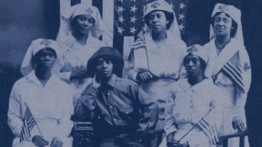
Adah Belle Samuels Thoms (1870 – 1943) was a prominent nurse who co-founded the National Association of Colored Graduate Nurses (NACGN) in 1908. While she did not graduate from The Cooper Union, she attended its free weekly elocution courses, which were open to men and women at the turn of the last century to improve their public speaking skills and job opportunities.
Thoms used those skills to establish NACGN "to advance the standards and best interests of trained nurses, to break down discrimination in the nursing profession, and to develop leadership within the ranks of Black nurses." Thoms served as its first treasurer before becoming president in 1916, a role she held for seven years. Under her tenure NACGN established its first headquarters and started a national registry to help Black nurses find employment.
Thoms, who was born in Richmond, Virginia, moved to Harlem in 1893 to further her education, eventually attending free elocution courses at The Cooper Union a few years later. She received her nursing degree in 1900 from the Women's Infirmary and School of Therapeutic Massage, the only Black woman in her class of 30. She then trained at the Lincoln Hospital and Home School of Nursing, graduating in 1905.
Thoms, who also authored the 1936 book, Pathfinders: A History of the Progress of Colored Graduate Nurses, lobbied for Black nurses to serve as American Red Cross nurses during World War I and eventually as U.S. Army Nurse Corps nurses starting with the flu epidemic in December 1918. She was among the first class of nurses inducted into the American Nurses Association Hall of Fame in 1976.