CHRIS MIGNANO ME'21
What if the next place you get a heart isn’t a hospital, but outer space? It sounds like science fiction, but Chris Mignano, a 2021 graduate of the Albert Nerken School of Engineering, is already thinking about what it would take to make that kind of future possible.
Imagine a patient in Boston in need of a heart with only days to live. In the future, she could be saved by a heart 3-D printed in space since organs have a far better chance of not collapsing when manufactured in zero gravity. The challenge, Mignano points out, is what happens next: “It’s not sustainable to have a system where you launch it from Florida, 3D-print it, it lands in the Pacific Ocean, and then you figure out a way to get it from the Pacific Ocean to New England.”
His solution is to launch and land closer to where you need to go, with space becoming part of the transportation and manufacturing infrastructure of everyday life.
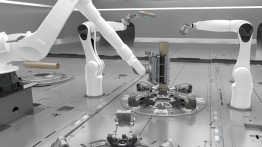
Today, Mignano is helping build that future at iRocket, a Long Island aerospace company developing propulsion systems for commercial space and military applications. At the company’s Factory One in Hauppauge, he works with a growing team of engineers on rockets and propulsion technology designed to make access to space more flexible, practical, and affordable.
“Opening the gate and opening space as a place where we can manufacture is the really exciting part about where we are right now,” he says. That “gate” is already beginning to crack open. Instead of space being the exclusive domain of enormous government programs, more companies are building satellites, using rideshare launches and developing their own propulsion systems. Mignano sees a future in which space supports research, medical manufacturing, computing, and entirely new industries. The possibilities are huge, but so are the engineering problems.
iRocket’s specialty is propulsion, that is, “building the engines and the rockets that get the vehicles to space.” The company is also working on propulsion and rockets for military applications. Its approach focuses on smaller, more specialized systems rather than the enormous launch vehicles associated with the biggest aerospace companies. For Mignano, that kind of focused manufacturing could help make space more accessible to companies that don’t have the resources of a Boeing or SpaceX.
The applications could extend well beyond satellites. Mignano talks about medical and space manufacturing, including the possibility of producing things in microgravity that are difficult or impossible to make on Earth. The 3-D-printed heart is deliberately futuristic, but it illustrates his point: once access to space becomes easier, imagination becomes the limiting factor.
Mignano, a mechanical engineer, has been thinking that way for years. At Cooper, he was part of the team behind the Cooper Cube, a giant functioning Rubik’s Cube that grew out of a design-class project. The experience fits neatly with the way he approaches engineering now: start with something that sounds a little crazy, then figure out how to build it.
But there’s another Cooper lesson that has followed him into aerospace, one that becomes especially important when the technology has military implications.
“I think [it] comes from Cooper and from engineering in general,” Mignano says. “If I’m going to make this thing, what are the implications of it? How does it affect society? And is there a way that I can do this so that it is better for society versus worse?”
Mignano is candid about that tension between the advantageous possibilities of rockets and their serious security implications. “Most of us are doing this stuff because we want to see space become a massive economy,” he says, but from a security perspective, “those things always go hand in hand.”
That may be what makes Mignano’s vision of space particularly compelling. He isn’t interested in space simply because rockets are exciting. He’s interested in figuring out what we should or could do once we get there.