Estonian Academy of the Arts
Competition 2008
(with Daniel Schuetz; associate team member: Anna Zagol)
The desire to express the individual character of the artistic disciplines, while establishing the unity of the institution as whole, is a key to the understanding of the Estonian Academy of Arts, and of its architectural design.
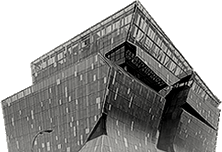
Urbanism: The academy is a compact, autonomous building, situated on a relatively small lot in the midst of the of Tallinn. The compact form of the building addresses the spatial constraints of the site. It expresses the role of the academy as an important public institution, architecturally and urbanistically distinguished from the corporate developments surrounding it. The building reacts spatially to the street and neighboring buildings through cuts into and extrusions from its main volume.
Field of Paintings – Stack of Programms: The studios, auditoriums, workshops, and faculty offices with their unique spatial requirements are treated as individual programmatic “boxes” with varying lengths, heights, and depths, which are assembled in a dense stack. The center of the stack consists of programs without daylight requirements. The programs along the perimeter of the stack are open to one side like three-dimensional picture frames, displaying their activities to the street. The roof of the building, the top of the stack, is the fifth elevation, visible from the surrounding high-rise buildings.
Structure: The structure of the building consists of interlocking horizontal and vertical concrete slabs, arranged in an irregular three-dimensional framework of cells, like a sponge. These structural cells vary in size and shape to accomodate different spatial volumes. They are programmatically neutral and internally flexible to allow for future functional changes. They can be fitted out and finished on the interior in accordance with the requirements of the inhabiting program. The non-hierarchical nature of the academy’s architecture allows for expansion in all directions by simply adding further cells.