Public Art Fund Talks: Thaddeus Mosley
Wednesday, October 29, 2025, 6:30 - 7:30pm
Add to Calendar
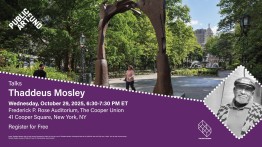
Artist Thaddeus Mosley and Public Art Fund Assistant Curator Jenée Daria Strand will be in conversation about Touching the Earth, Mosley’s first public art exhibition in New York City, on view at City Hall Park through November 2025. The exhibition features eight bronzes recently cast from wood sculptures Mosley created between 1996 and 2021.
At 99 Mosley has spent more than six decades investigating the expressive potential of natural materials. His intuitive process transforms fallen timber into abstract reflections on nature, the body, and geography. In this conversation, Mosley will reflect on the conceptual framework behind Touching the Earth, his improvisational studio practice, and the ways his lifelong engagement with form and material has shaped one of the most significant bodies of work in contemporary sculpture.
Attend in person at The Cooper Union’s Frederick P. Rose Auditorium. Registration is required, and capacity is limited. Seating is first come, first served so please arrive early. Your registration does not guarantee a seat. Doors will close at 6:45pm. Register here for free.
Accessibility: Email Gabriela López Dena, associate curator of public practice, at glopez@publicartfund.org with questions and requests for accessibility. Please send any needs for services or accommodations to support your participation in this program, including ASL interpretations, hearing aids, and simultaneous translation, by October 3.
Thaddeus Mosley (b. 1926, New Castle, Pennsylvania) creates monumental sculptures crafted from the salvaged wood from Pennsylvania’s forests. Using only a chisel and gauge to maintain the integrity of the original log, Mosley reworks timber—primarily from indigenous Pennsylvanian hardwoods such as cherry and walnut—into biomorphic forms. Through a process of direct carving, the artist’s marks respond to and rearticulate the natural gradations of the material’s surface. With influences ranging from Isamu Noguchi to Constantin Brâncuși—and the Bamum, Dogon, Baoulé, Senufo, Dan, and Mossi works of his personal collection—Mosley’s “sculptural improvisations,” as he calls them, also take cues from the modernist traditions of jazz. “The only way you can really achieve something is if you’re not working so much from a pattern. That’s also the essence of good jazz,” he says of his method. Mosley lives in Pittsburgh, PA.
Mosley’s work has been presented in institutional solo exhibitions at the Nasher Sculpture Center, Dallas (2023); Art + Practice, Los Angeles (2022); and Baltimore Museum of Art (2021), as well as group exhibitions at the Bergen Kunsthall, Norway (2022); Harvard Business School, Boston (2020); Sculpture Milwaukee (2020); Carnegie Museum of Art, Pittsburgh (2018); and Mattress Factory, Pittsburgh (2009), among others. His sculptures are held in the collections of the Art Institute of Chicago; Baltimore Museum of Art; Brooklyn Museum, New York; Carnegie Museum of Art, Pittsburgh; Colby College Museum of Art, Waterville, Maine; Solomon R. Guggenheim Museum, New York; High Museum of Art, Atlanta; and the Whitney Museum of American Art, New York City.
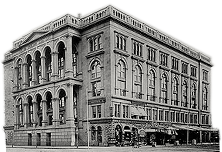
Public Art Fund Talks, organized in collaboration with The Cooper Union, connect compelling contemporary artists to a broad public by establishing a dialogue about artistic practices and public art. The Talks series features internationally renowned artists who offer insights into artmaking and its personal, social, and cultural contexts. The core values of creative expression and democratic access to culture and learning shared by both Public Art Fund and The Cooper Union are embodied in this ongoing collaboration. In the spirit of accessibility to the broadest and most diverse public, the Talks are offered free of charge.
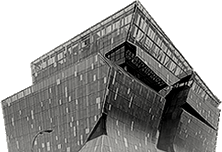
Located in the Frederick P. Rose Auditorium, at 41 Cooper Square (on Third Avenue between 6th and 7th Streets)