The Diane Lewis Student Lecture Series | Manuel Bouzas: Reporting From the Field
Tuesday, November 3, 2026, 6:30 - 8:30pm
Add to Calendar
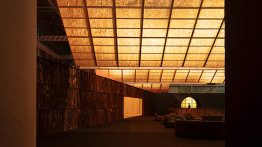
Image: ARCO Lounge, courtesy of Luis Diaz.
This event will be conducted in-person in Room 315F and through Zoom.
For in-person attendance, please register in advance here.
For Zoom attendance, please register in advance here.
Manuel Bouzas is a Spanish architect, curator, and educator based in Galicia and Upstate New York. His work examines the environmental externalities of productive processes by looking at the materials we build with and the landscapes from which they are sourced.
He is an Assistant Professor at Cornell University’s College of Architecture, Art, and Planning and co-editor of Obradoiro, the journal of the Galician Institute of Architects. In 2025, he received the Princess of Girona Arts Award, presented by the Spanish Royal Family, and served as curator of Internalities, the Spanish Pavilion at the 19th Venice Architecture Biennale.
Through his practice, MB—AE, he has designed multiple urban installations and exhibitions across Southern Europe, including 350,000 Ha (Madrid, 2026), Atlas (Braga, 2025), Cabane 7L (Rome, 2024), and Mediterráneo (Valencia, 2023), developed with the support of the Government of Spain, Villa Medici, ARCO, Fundación Arquia, Massimo Dutti, and CHANEL.
His work has been featured at the Spanish Pavilion at the Venice Architecture Biennale (2018, 2023, 2025), the Oslo Architecture Triennale (2026), the Spanish Architecture and Urbanism Biennial (2021, 2025), and the Biennale d’Architecture et de Paysage de Versailles (2025).
Manuel holds an M.Arch from the School of Architecture of Madrid (ETSAM) and a Master in Design Studies from the Harvard Graduate School of Design.
The lecture will be followed by a Q&A moderated by Helena Uceda.
This event is free and open to the public. Registration is required.
Located at 7 East 7th Street, between Third and Fourth Avenues