The Diane Lewis Student Lecture Series | Guillaume Othenin-Girard: Drawing Into Place
Tuesday, September 29, 2026, 7 - 8:30pm
Add to Calendar
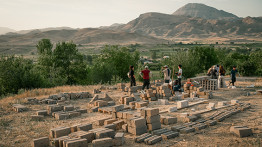
Archaeological Field Lab, Building in Common, Urtsadzor, Vedi River Valley, Armenia, 2025. Project lead: Guillaume Othenin-Girard, HKU. Photograph by Guillaume Othenin-Girard.
This event will be conducted in-person in 315F and through Zoom.
For in-person attendance, please register in advance here.
For Zoom attendance, please register in advance here.
The lecture explores ways of working between architecture and archaeology to shape the future of cultural landscapes and heritage programmes. At the pre-Columbian sanctuary of Pachacamac in Peru, the Pachacamac Atlas and A Room for Archaeologists and Kids grew from work with students and local partners to read the territory and build within it. In Armenia’s Vedi River Valley, The Glkhatun Experiment draws on local building traditions in the design of an archaeological field laboratory. Survey drawing and participatory forums bring archaeological remains into relation with the wider inhabited landscape, informing an interpretive strategy for the valley. Choices about what to draw and how to draw it shape the way a place is understood and begin to suggest how architecture might intervene. Building together tests these readings against local knowledge and the materials at hand. These projects work towards an architecture of attunement: an architecture that encompasses an archaeological approach to time, in which design narratives emerge from readings of the ground and reinforce cultural and social meanings.
The lecture will be followed by a Q&A moderated by Vasily Chumakov.
Guillaume Othenin-Girard is an architect and assistant professor in the Department of Architecture at the University of Hong Kong. Working at the intersection of architecture and archaeology, his research and teaching move between territorial survey and full-scale construction. Through drawing, he explores the histories and latent possibilities of cultural landscapes under pressure, with the aim of keeping heritage open to collective use and transformation. He was a founding member of the design research collective TEN and is a co-founder of Architecture Land Initiative (ALIN), a cooperative based in Switzerland and Hong Kong, working with public institutions and local groups across architecture and landscape transformation. His work has been exhibited at venues including the Venice Architecture Biennale, the SACO Biennale, artgenève and Art Basel. His designs and writings have appeared in publications including The Architectural Review, Drawing Matter, DETAIL, Divisare, Domus and Mousse. Before joining HKU, he taught at EPFL and ETH Zurich.
This event is free and open to the public. Registration is required.
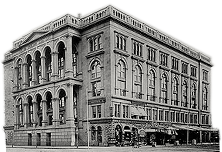
Located at 7 East 7th Street, between Third and Fourth Avenues