Kerestell Smith ME’12 Reimagines Virtual Reality Gameplay
POSTED ON: October 23, 2025
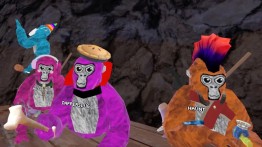
Kerestell “Lemming” Smith, is the founder of Another Axiom, the company that produces the highly successful virtual reality (VR) game Gorilla Tag. Smith, who graduated from Cooper’s Albert Nerken School of Engineering in 2012, spoke to us about he came to the field of game design. Smith studied mechanical engineering, but today, a Cooper student interested in game design would have the option of studying computer science, a new degree program that welcomed its first class of students this fall and offers a curriculum focused on project-based learning. In this interview, Smith talks about the development of Gorilla Tag, his experiences at Cooper, the longevity of childhood handles, and the ways that goal-oriented projects gave him the skills needed to design a VR game that has over 10 million users.
How did you come up with the idea of Gorilla Tag? Is it Another Axiom’s first game?
Gorilla Tag was sort of an accident; it actually started as a gesture-based spellcasting game. It started around the end of 2019. Although I wasn’t a game developer, I was frustrated at the state of the VR industry. I felt like, while a lot of people were trying a lot of cool things, I wasn’t seeing much that seemed to be building on things that came before.
The game that really sparked my imagination was called Echo Arena, a zero gravity sports game where you’re trying to pass a disc up a field and score a goal. The way you moved felt exactly like how you imagine it would feel to float in space: you’d grab a wall, push off, and float in the opposite direction. That really direct relationship with the environment gave you a very strong feeling of “being there,” which I think is the greatest strength of VR. However, that game came out in 2017, and I didn’t really see anything that felt like it was trying to build on that kind of movement model. I figured if I thought I was so smart about what’s cool in VR, I should try to make something myself.
Why do Gorilla Tag’s apes have no legs?
I had been noodling around with some not-very-promising prototypes for spellcasting when I decided that, at the very least, I wanted to be able to move around in a way that felt natural. I went back to that movement and thought about how I could make it work with gravity (since zero gravity is finicky in a lot of ways), and that also didn’t require you to grab the actual environment. I had the thought of trying to walk on your hands, and so after I gave that a shot, it instantly felt incredibly satisfying. VR isn’t a great map for actual reality, in terms of your control inputs. Because your legs have to stand on the real-life ground, they can’t move you around the virtual space. But, since your hands are floating, they can, so if you cut yourself off at the waist, you can keep your upper body fully in VR. So the feeling of walking around, just on your hands, translates incredibly well, since you don’t have to think about your interactions with the real world. It makes a lot of sense when you try it, but it’s hard to think about without that context. That’s what I found really fun about the building process. Iteration teaches you so much more than just trying to think really hard about what you want to make.
The problem there was that I didn’t know how to turn it into an actual game. It took a few months before I had the idea of trying to add tag, but the first time I got the multiplayer working and I could see someone else and chase after them, everything clicked. It didn’t feel like I was playing a game about playing tag. I could feel it in my whole body that there was something over there that I had to chase. And when you’re being chased, you aren’t thinking about the layers of indirection between you and the experience. All you feel is that something is coming after you and you have to get away, and the way you do that is by flinging your arms and running as fast as you can. That kind of experience you feel in your whole body is what makes VR a unique medium.
How did you discover The Cooper Union?
I grew up in Mamaroneck, New York, in Westchester, and I had heard about Cooper from a family friend while I was still in high school. It sounded like a great program, so I applied. I moved out to California for work after college and moved back to New York recently. I’ve been living in Manhattan for a bit over a year.
You studied mechanical engineering, but did your coursework help you with the skills you need for computer engineering?
The biggest thing to me is project-based learning. The details of specific courses are not so relevant. (Unfortunately, I’ve never had to use any heat transfer equations.) But to me, the goal of the work is to make something. I always wanted to build tangible things I could pick up and look at, and although I ended up coding all day, working on VR does involve a lot more tangibility than other types of software.
I started to learn how to figure out what was most important to make a project happen, skip over details of less relevant points, and work to come out with a final thing that does something. That skill is tough to develop.
It’s much more straightforward to operate in a smaller box of trying to solve one specific problem, but to integrate a lot of different things that are going on, keep track of everything that needs to get made, and pull it all together is something that takes practice and time to learn. I think the focus on projects really helped me a lot to develop those skills. Learning to write code in college was probably the most important skill I learned.
The graphics of Gorilla Tag are so appealing! Did you study design at all or take any art classes at Cooper? Did being near the School of Art have any influence on you? In your time at Cooper, there were fewer cross-disciplinary opportunities.
I did take one or two, but ones that were specifically for engineers. Unfortunately, I didn’t have too much overlap with the art or architecture students. These days we have a bunch of incredibly talented artists working on the game, so I can’t take credit for their work, but early on I was targeting a do-what-you-can-with-what-you-have approach. I was a fan of the old PlayStation 1 style graphics and used an online tutorial as the basis for most of what I was doing. It was something that was relatively simple and straightforward but still let me have a more cohesive style for the game.
Why are you called “Lemming”?
That was my internet name that ended up sticking (I played a bunch of first-person shooter games where I would blindly dive into the enemy and get killed). I’ve always tried to be active in my communities, so that name just ended up being how everyone referred to me. It’s kind of funny how long you can be tied to a name you picked for yourself when you were 13.
What do you think is the reason behind Gorilla Tag’s great success?
Fundamentally, I think it’s an extremely strong fit for the technology. Moving with your hands is very visceral and natural, which gives you a strong connection to the virtual world and makes you feel very present in the space. The social interaction is extremely compelling. You really feel just like you’re back on the playground playing tag, and it’s a very honest feeling. I think younger players also don’t have as many preconceived notions of what VR “should” be, so they’re able to engage more objectively with what’s interesting and compelling about the experience.
Gorilla Tag is a VR game, but can you play it on a screen without VR glasses?
You cannot. It was built from the ground up for VR. One of the core interactions that I really love in the game is that the harder you push yourself and the faster you move in real life, the faster you can move in the game. If you’re plodding along at a leisurely pace, you’re going to get caught by someone sweating and whipping their arms around as fast as they can. Compare that to most kinds of games where a lot of the balance is in what your character’s stats are. For those games, you’re limited in your speed by the game itself, and if you’re holding forward on the joystick, that’s just as fast as you can go. Breaking that game-enforced limitation and putting it on your physical body is a huge part of why the game is so interesting. Even if you don’t always choose to put all your energy into it, the fact that you can makes it more interesting.
What’s next for Another Axiom?
We’re looking to keep expanding Gorilla Tag as our core game, but we’ve already released a second one, Orion Drift, into early access, which is much more ambitious in terms of the technology and the spaces we can create. Right now, that game has a giant O’Neill cylinder space station that can house up to 75 players at the same time in one server. You can play different sports and activities with anyone on the station. We’re shooting to have up to 200 people in one station, and our plan is to use that tech to make more games in the future.