Distinguished Professorships Awarded to Faculty in Engineering
POSTED ON: September 25, 2025
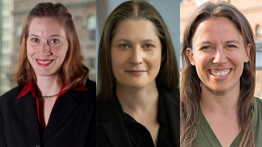
Left to right: Professors Melody Baglione, Jennifer Weiser, and Amanda Simson.
The Albert Nerken School of Engineering has appointed three faculty members to distinguished professorships: Jennifer Weiser, Associate Professor of Chemical Engineering, as the Distinguished Professor in Bioengineering; Amanda Simson, Associate Professor of Chemical Engineering, as the C.V. Starr Distinguished Professor of Engineering; and Melody Baglione, Professor and George Clark Chair of Mechanical Engineering, as the inaugural IDC Foundation Distinguished Professor.
Professor Jennifer Weiser, Distinguished Professor in Bioengineering
Associate Professor of Chemical Engineering, Jennifer Weiser, has been appointed as the Distinguished Professor in Bioengineering. Awarded by the Deans of the Albert Nerken School of Engineering, the named professorship goes to mid-career, tenured, associate, or full professor faculty members with documented research accomplishments in bioengineering or a closely related field including peer-reviewed journal, conference papers, and presentations as well as evidence of scholarly collaboration with other institutions and/or corporations. The distinction lasts for three years and comes with a $20,000 annual stipend for research activities such as travel, research assistants, equipment, and supplies.
Weiser received her M.S. and Ph.D. in Biomedical Engineering from Cornell University, where she leveraged her previous work experience as an exploratory medicinal chemist at Wyeth Pharmaceuticals to develop polymeric biomaterials for drug delivery and wound healing applications. After graduate school, she joined the startup iFyber through a NIH STTR grant to explore proprietary polymeric materials developed in her lab. In 2014, she began a NIH Ruth L. Kirschstein NRSA postdoctoral fellowship at Yale University before joining the full-time faculty of The Cooper Union in 2017.
At Cooper Union, Weiser focuses on developing solutions for medical applications and forming multidisciplinary teams to address healthcare and bioengineering challenges. External collaborators include Mount Sinai, Rowan University, University of Wisconsin, Rensselaer Polytechnic Institute, Università Telematica San Raffaele, and Technische Universität Graz. Internal collaborators include Professor Mili Shah, Professor Radmila Janjusevic, and Professor Amanda Simson. Her recent projects include biomaterials for tissue repair, 3D printing cells, bioadhesive hydrogels for post-radiation therapy treatment, biosensors for body tracking, and polymers for direct air carbon capture. She also works to expand hands-on opportunities for undergraduates and foster an entrepreneurial mindset in the classroom.
Weiser was honored with a Fulbright U.S. Scholar Program Award for her expertise in biomaterials and educational pedagogy. From 2024–2025, she served as the Fulbright-Graz University of Technology Visiting Professor in Graz, Austria, teaching graduate courses in Biomaterials-Tissue Interaction and Drug Formulation and Delivery while collaborating on biomaterials research. She has previously held Visiting Professor appointments at Yale School of Medicine and Columbia University Medical Center.
Professor Amanda Simson, C.V. Starr Distinguished Professor of Engineering
Associate Professor of Chemical Engineering, Amanda Simson, has been named the 2025 C.V. Starr Distinguished Professor of Engineering. Awarded by the Deans of the Albert Nerken School of Engineering, the professorship recognizes mid-career, tenured faculty with documented research accomplishments and a commitment to interdisciplinary collaboration. The distinction lasts for two years and comes with a $20,000 annual stipend for research activities.
Simson received her Ph.D. from the Earth and Environmental Engineering Department at Columbia University and worked as a fuel processing engineer for a solid oxide fuel cell start-up before transitioning to academia. She has spent her career focused on developing and analyzing climate change solutions. Her research focuses on re-envisioning waste using biomass like felled trees or coffee grounds for energy or carbon dioxide reduction and usable materials. Her current focus is on creating biochar—a solid carbon product created from organic waste—in NYC, understanding health impacts, reaction requirements, and potential small-scale reactor designs for this process.
She has created new courses on Carbon Dioxide Removal Technologies and Environmental Catalysis and enjoys teaching Thermodynamics with a focus on climate technologies. She is currently working on a textbook supplement on this topic to be published in 2026 with Taylor and Francis. She also teaches the senior lab course and likes making students build things.
Simson enjoys collaborating with her colleagues and friends and believes in the power of interdisciplinary work (and friendship!). Currently, she is working on climate solutions journalism articles with Professor Abby Rabinowitz of New York University, new carbon capture materials with Professor Jennifer Weiser, and a new course on Chemical Engineering, Film, and Ethics with Professor Abhishek Sharma.
Professor Melody Baglione, IDC Foundation Distinguished Professor
Professor and George Clark Chair of Mechanical Engineering, Melody Baglione, has been appointed as the inaugural IDC Foundation Distinguished Professor. The three-year professorship supports mid-career faculty who advance interdisciplinary work in the building, design, and construction fields. The appointment includes an annual budget of $20,000 for activities such as travel, research assistants, equipment, supplies, installations, and exhibitions.
Baglione earned her Ph.D. in Mechanical Engineering from the University of Michigan in 2007. Before transitioning to academia, she spent over seven years as a management consultant and powertrain systems engineer. Her commitment to sustainability in education was recognized with a National Science Foundation (NSF) Transforming Undergraduate Education in STEM (TUES) grant, which supported the integration of building sustainability into the curriculum and engaging students in research to improve energy efficiency and reduce the carbon footprint of the built environment.
Through her leadership, Cooper Union secured funding from the New York State Energy Research and Development Authority (NYSERDA) under the REV Campus Challenge Technical Assistance programs. This enabled campus-wide energy audits, retro-commissioning efforts, and the development of energy master and climate action plans.
Baglione has collaborated across disciplines to co-develop and co-teach innovative courses such as Energy Efficient Building Systems, Environmental Technologies, Smart Cities, and Solar Decathlon Vertically Integrated Projects (VIP), Interdisciplinary Capstone Projects, and a building design collaborative workshop. These courses have attracted students from architecture, art, and all engineering majors. Faculty collaborators include John Rundell, Cosmas Tzavelis, and David Wootton from the School of Engineering, and Pamela Cabrera and Tommy Schaperkotter from the School of Architecture.
Her work advances Cooper Union’s mission by fostering cross-disciplinary collaboration and building partnerships with industry, community organizations, and government agencies. These initiatives enrich the curriculum and expand hands-on, project-based learning opportunities—preparing students to lead in developing climate adaptation strategies across the building, design, and construction sectors.