CUSLI Awarded a NASA New York Space Grant
POSTED ON: November 10, 2025
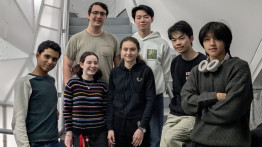
The student-led Cooper Union Satellite Launch Initiative (CUSLI) has been awarded a NASA New York Space Grant - Opportunity Grant, which supports hands-on NASA related research and programming to study the properties of e-paper, the display technology used in many electronic readers. Since 2022, CUSLI has been researching, designing, and building a satellite that they hope will be launched into space to conduct an experiment on the thermal properties of e-paper as part of NASA’s annual CubeSat Launch Initiative. CubeSats are a standardized class of small satellites, often referred to as a nanosatellite, that are roughly the size and square shape of a Rubic’s Cube. The NASA program provides students a low-cost opportunity to conduct space research by flying the student-developed satellites in NASA missions.
“E-readers draw virtually no power when the screen is stable, so we want to explore if it could be used to improve onboard thermal regulation for small satellites,” says mechanical engineering junior Oscar Chen. “We are trying to determine the properties of e-ink in space through bench experiments. If it exhibits the properties and behavior that we want, then we can explore developing it into an applicable thermal tool.”
The Cooper club currently has ten active members, four of whom participate as part of the Albert Nerken School of Engineering’s Vertically Integrated Projects (VIP) program. VIP allows students to research real-world problems over multiple semesters under the guidance of faculty. Michelle Rosen, assistant professor of mechanical engineering, is the faculty advisor. This is their second NYSG grant.
For now, in addition to their study of e-paper, the team is focused on getting their CubeSat’s individual subsystems functioning. Chen who got involved with CUSLI during his first year at Cooper, thinks they will be ready to apply to launch their satellite through NASA in a few more years.