Cooper Underdogs Win Big in Concrete Toboggan Race
POSTED ON: February 23, 2026
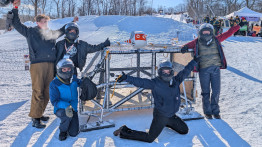
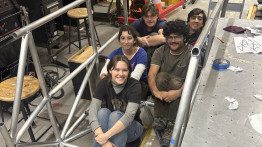
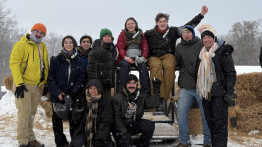
This month, The Cooper Union Toboggan Team won five first-place awards and third place overall in its competition debut at the 2026 Great Northern Concrete Toboggan Race (GNCTR) in London, Ontario. Facing off against students from 17 Canadian colleges and universities, the Cooper team won Best Performing Toboggan, Best Braking Performance, the People’s Choice Award, and Best New Team, among several other top honors.
The annual event is Canada’s largest and longest running engineering competition, drawing more than 400 university students to design, construct, and race five-person toboggans that slide downhill on skis made of waxed concrete. The nine-student team from Cooper’s Albert Nerken School of Engineering were the only ones representing a US institution in this year’s race.
Co-captains Josef Kucher, a senior in mechanical engineering, and Elise Danko, a senior in general engineering, discovered the competition after watching Cool Runnings, a film about Jamaica’s national bobsled team defying expectations to qualify for the 1988 Winter Olympics. Like the underdogs portrayed in the movie, the Cooper students faced long odds against seasoned competitors.
“We initially had no idea what a concrete toboggan is,” Kucher says. “What could a brake look like? How do you design concrete skis for a 350-pound toboggan?” The team consulted past competitors’ technical reports, refined their design through engineering course projects, and sought guidance from Cooper faculty to develop braking and steering systems, produce a safety report, and ensure their sled’s frame could withstand high-speed runs.
The students also made use of Cooper’s facilities to build their toboggan from the ground up, an effort that earned them first place for Excellence in Student Construction. “I’m especially proud that every component of our toboggan is student-fabricated,” says Danko. “That seemed to be rare among other teams.”
The Cooper students were the smallest team to qualify for the 2026 race, so each member played several roles in designing and building the sled, from welding the frame to managing finances to waxing the skis. Alongside the two captains—and with staff support from shop technician Max Summers—the group included mechanical engineering seniors Xano Sweeting and Tre Brown, civil engineering juniors Gianna Allegretti and Chris Lin, electrical engineering junior Ayla Rinsky Bryant, and mechanical engineering junior Dylan Qiu. Clarice Kuang, a mechanical engineering major and the only first-year student on the team, was the first to drive the sled when it was moved from the unloading area to the pits.
“People kept telling us, ‘It’s great you’re competing, but don’t be surprised if you don’t make it to the bottom of the hill or even pass safety inspection,’” says Danko. “We ended up having the best performance for a new team in over 30 years.”
Beyond the race itself, the GNCTR weekend featured a technical exhibition, industry events, and networking opportunities. Teams were also judged on several off-slope criteria, including design abilities, technical presentations, project management skills, and spirit, which involved a sketch performance at the race’s opening ceremonies, with Allegretti and Rinsky Bryant taking the lead as spirit captains. Danko handcrafted her teammates’ costumes, which took thematic inspiration from the 2011 animated film Rio.
“The engineering on display was really impressive, especially during the technical exhibition, but it was also just a lot of fun,” Kucher says. “Though half the team is graduating, I’m really hopeful that the team continues next year. There is also so much room for art and architecture students to contribute. It’s one of the things that makes GNCTR really unique among engineering competitions.”