Assistant Prof. David J. Kim Publishes Research on Magnesium Recovery from Seawater
POSTED ON: August 17, 2026
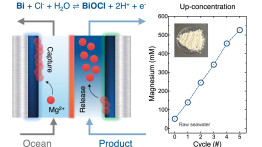
Assistant Professor, David J. Kim, has published a paper on “Direct Magnesium Recovery from Ocean Waters Using Bismuth Electrochemistry” in the ACS Energy Letters.
Read more about the research on the Science News Release.
Abstract
Magnesium (Mg) is a valuable commodity across many industries, including metals production, transportation, chemical processing, and agriculture. Our oceans effectively represent a limitless source of Mg, and there is subsequently much interest in developing technologies for its recovery in an environmentally sound manner. Herein, we present a new approach to up-concentrate Mg supplies from raw seawater using bismuth (Bi) electrochemistry. Our Bi electrodes can reversibly adsorb and uptake magnesium without deactivation from scale formation. The collected Mg is then released to generate separate MgCl2 product streams with high selectivities over sodium and other seawater constituents. Our approach does not require auxiliary chemical supplies and can continuously increase MgCl2 concentrations from ∼50 to >500 mM by sequentially reusing the concentrated extract from each cycle as the receiving solution for the next. The system demonstrates stable operation for >200 h at consistently low energetics (<600 mV).