Camille Hoffman
Adjunct Professor
Camille Hoffman is a painter who critically reimagines the romantic American landscape through layered and immersive site-specific installation. Her practice re-threads misplaced histories, materials, and ancestral geographies, including those of the Philippines and the Americas, by resculpting artificial, mass-produced vinyl landscapes through handwork — collage, sewing, and painterly gesture. Through this tactile transformation, she builds sacred in-between spaces that evoke the sensory experience of moving between multiple places and identities at once. Informed by historical research, community-oriented conversations, and dreams, these spaces intend to be activated by the land they live on, the architecture that houses them, and the people who visit.
Camille Hoffman (b. 1987 Chicago, IL) earned an MFA from Yale University (2015), a BFA from California College of the Arts (2009), and was a recipient of the Carol Schlosberg Memorial Prize for excellence in painting from Yale University, the BRIC Colene Brown Art Prize (2022), a National Endowment for the Arts scholarship, a Benjamin A. Gilman International Scholarship, and the Van Lier Fellowship from the Museum of Arts and Design (MAD). She has exhibited her work throughout the United States and abroad and has been featured in publications including Art in America, the Los Angeles Times, Hyperallergic, and The New Yorker. Solo exhibitions include Parenthetic Passages, Pennsylvania State University (2025), Soft Gaze, BreckCreate (2023), Listen Lines, Time Equities Art in Buildings (2023), Motherlands at Form & Concept ( 2022), See and Missed at San Luis Obispo Museum of Art (2022), Landing For Lolo at NADA House Governors Island (2021), Excelsior: Ever Upward, Ever Afloat at the Queens Museum (2019), and Pieceable Kingdom at the Museum of Arts and Design, New York, NY (2018). Hoffman has been an artist-in-residence at Fountainhead, Miami, FL (2021), Lower Manhattan Cultural Council SU-CASA (2019), Children's Museum of Manhattan, New York, NY (2018), Wave Hill Winter Workspace, Bronx, NY (2018), QueenSpace, Long Island City, NY (2017), Museum of Arts and Design, New York, NY (2017), and Yale University Office of New Haven and State Affairs, New Haven, CT (2015). Hoffman has also worked for two decades as an arts educator in Phoenix, the SF Bay Area, New Haven, and New York City. She currently lives and works in Brooklyn, NY, and serves as Adjunct Professor at The Cooper Union.
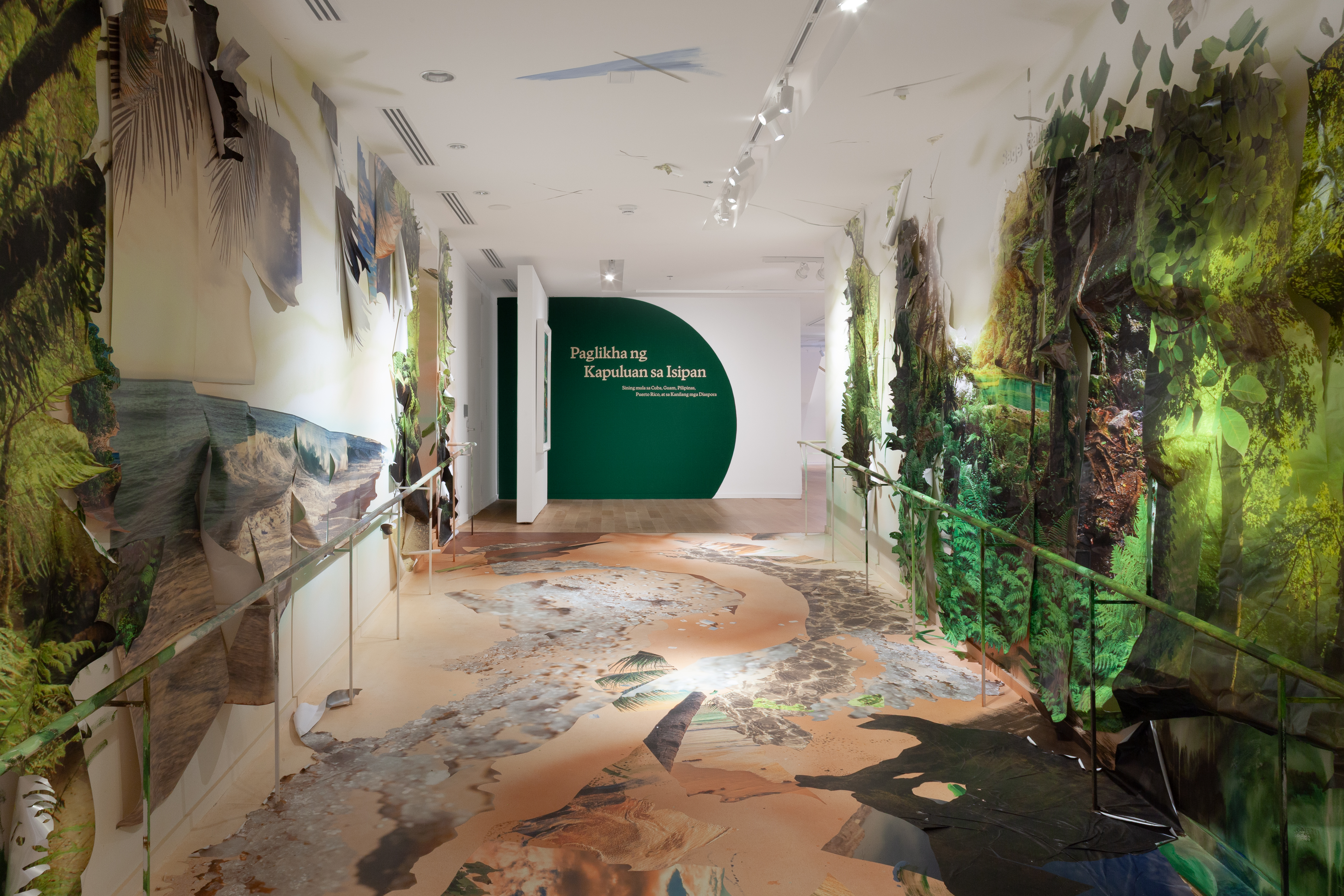
Site-specific commission for Imagining an Archipelago: Art from Cuba, Guam, the Philippines, Puerto Rico, and Their Diasporas, Colby Museum of Art. Watercolor, acrylic, tropical landscape stock vinyl, reproduction of Charles Codman's The Forest Near Portland, Maine, and photographs of salt from the Philippines and the Americas, with photographs created in collaboration with Andre Taylor.