From St. Mark’s to Santa Fe
POSTED ON: January 12, 2026
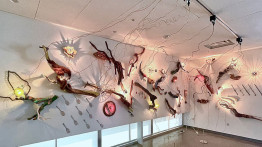
Jay Zeiger, RAVENOUS. 1996. Found objects, 36 x 8 x 3 ft.
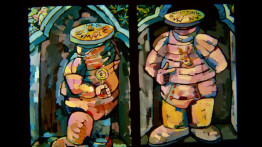
Geraldine Fiskus, Made in Taiwan. 1993. Oil. 40 x 56 in.
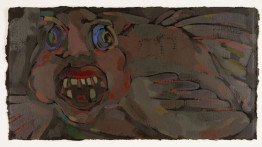
Geraldine Fiskus, Fischl & Karpl. 1999. Oil on watercolor paper with black gesso ground, 12 x 22 in.
Geraldine Fiskus and Jay Zeiger, both 1965 graduates of The Cooper Union School of Art, are among the generation of artists who, beginning in the 1970s, traded the art scene of the big city for the high deserts of New Mexico. That creative migration was the focus of Off-Center: New Mexico Art 1970–2000, a landmark exhibition at the New Mexico Museum of Art that brought together many of the artists who helped shape the region’s cultural landscape, including this Cooper Couple.
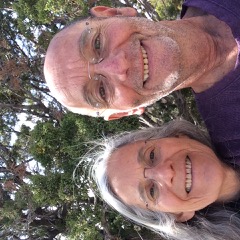
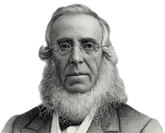
Both born in New York City, Fiskus and Zeiger first crossed paths in a painting studio course taught by the influential educator Victor Candell (1903–1977). As students, the pair quickly hit it off, moving into an apartment together on St. Mark’s Place and earning scholarships to attend the Provincetown Workshop, a summer art program. Candell had established the workshop in 1958 alongside fellow Cooper professor and artist Leo Manso (1914–1993), modeling it on the mission of The Cooper Union. “Candell’s critiques emphasized an authenticity and originality arising from cutting the cord with Western art history—exploring and exposing ourselves with no constraints,” Zeiger recalls. “He would tell us, ‘One can act on impulse on the canvas even though in public we’d be arrested for disrobing.’”
The couple married in 1964, in part so that Zeiger, opposed to the war in Vietnam, could avoid the draft, but their partnership endured well beyond circumstance. In 1971, Fiskus and Zeiger left behind city life for Roswell, New Mexico, joining an emerging creative community of artists seeking new inspiration in the open landscape of the American Southwest. “Our motivation was clearly fueled by our instructors at Cooper in the 1960s,” Zeiger explains. “We came to New Mexico to escape the pressures and constraints of the New York art scene and pursue our own personal paths in the context of the native cultures and the high desert environs.”
Eventually settling in Santa Fe, Fiskus and Zeiger have spent more than five decades making and teaching art. Their inclusion in Off-Center highlights the creative and personal trajectory that defined a broader movement of artists who relocated principally from the East and West Coasts to set up studios or practices in Santa Fe, Albuquerque, and Taos, as well as smaller New Mexico communities. Through the years, that movement included Bruce Nauman, Susan Rothenberg, Richard Mock, Luis Jiménez, Larry Bell, Meridel Rubenstein, Ron Cooper, Judy Chicago, Robert Smithson, Nancy Holt, Agnes Martin, Sam Scott, Sabra Moore, Florence Pierce, and John Connell, among many others.

Zeiger, who earned his M.F.A. from Claremont Graduate University, has focused his practice on collecting objects from nature and material culture. His installations enable unexpected and accidental relationships that re-contextualize the objects and their conventional purposes. RAVENOUS, exhibited as part of Off-Center, is an expanding arrangement of juniper branches that meander across a 30-foot wall, turning a corner and continuing for another ten feet. The installation was inspired by the arroyos and ravines of the high desert, which he describes as “gorging through the land, sweeping away and mixing the detritus of human and natural activity. My original motivation was to save common things before they disappear and to present them for speculation in a new light.”
Another work, Continuum, is similarly connected to place, salvaged from the caved-in roof of a 120-year-old adobe building that the artist purchased to use as a studio space. The piece of wood was one of the remnants of the massive roof beams, called vigas, common to traditional adobe architecture in New Mexico. “The sapling is emerging from the mature tree, which is now dissolving after having served to support the roof for many years,” Zeiger says. “For me this is a metaphor of our own lives.”
Made in Taiwan, a two-panel painting by Fiskus, was also featured in Off-Center. The piece was inspired by a headless toy figure that Fiskus found in the desert in 1993. Its name comes from the country-of-origin label embossed on the plug that held the lost head. Part of a series of work Fiskus calls “Alternative Icons,” the piece highlights themes of global interdependence and mutual influence. “This seemingly insignificant doll symbolizes the ultimate mixing of economic outsourcing with cultural and spiritual views,” she explains.
Her Fischl & Karpl series appropriates the fish motifs carved into Jewish gravestones in Eastern Europe. The work alludes to both Hitler’s plans to create museum exhibitions of “extinct” Jewish life and to the image of unfathomable oceanic depth found in the work of Auschwitz survivor Primo Levi, who wrote that “the only true witnesses were those who perished.” While the series is inspired by her family's experience, Fiskus sees it as an expression of the universal, ongoing, and horrific experience of all persecuted peoples. The black paper, with its torn edges, evokes black ash, while the anthropomorphized fish evokes the terror experienced by the victims.
Throughout their years in New Mexico, Fiskus and Zeiger have carried forward the pedagogical influence of Cooper, including an emphasis on risk-taking and mentorship. Fiskus has taught art courses and curated exhibitions at universities, community programs, art centers, and public schools across the state, while Zeiger developed and directed an art program for Eastern New Mexico University and expanded the art program at San Juan College in Farmington, New Mexico. He has presented talks and curated exhibitions at museums and other cultural institutions in New York, Arizona, New Mexico, and Israel. “We feel like we’ve brought a Cooper Union education and aesthetic awareness to our students and communities in New Mexico,” the couple says.
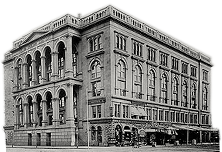
Six decades after they first met in the Foundation Building, Fiskus and Zeiger see their story as a testament to the enduring reach of a Cooper education far beyond New York. The artists are now hoping to publish an artist’s book that traces this shared journey. “This exhibition prompted us to reflect on how much of our work has been shaped by the life experiences we found in New Mexico and the creative independence that’s stayed with us from our time at Cooper,” Zeiger says. “Seeing our work exhibited in the context of artists and friends who came here seeking independence, we realized it’s time to place our life’s work and experience within the cultural continuum so that the ideals that have motivated us would endure and continue to inspire others.”