Designing for a Breakthrough
POSTED ON: May 27, 2026
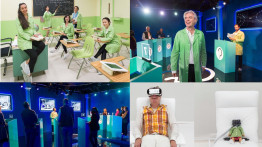
The Institute Presents: Neurosociety. David Byrne/Pace Gallery.
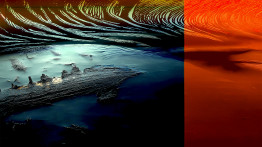
Eli Kuslansky, Shark Test. 2023. Archival pigment on Belgian linen, 77 x 44 inches.
This article appears in the Spring 2026 issue of At Cooper magazine.
It’s the nature of the universe that every time breakthrough, and the breakdown and break- through are commensurate in scale and depth.”
That’s how Eli Kuslansky A’73, an artist, interactive media executive, radio host, and journalist, describes cycles of creativity, not just in art but in all human endeavors. Take the COVID vaccine, he says. Kuslansky points out that from a worldwide tragedy emerged a new kind of vaccine that rewrites the RNA code of a virus, a whole new approach to fighting viral diseases.
Art is undergoing a radical shift too, he believes, and instead of resisting those changes, Kuslansky is all about exploring them. His color-outside-the-lines approach has led to a wide array of projects that share one feature: they all look to discern and expand the boundaries of technology and art, both ancient forms and those new on the scene.
As chief strategist and partner at Unified Field, an interactive media firm, he works on a wide range of projects. “We call ourselves a creative innovation firm. We create engaging media and digital experience ecosystems in public spaces. A lot of it’s to convey knowledge, to bring communities together, create enduring relationships, and to inspire curiosity.”

The work suits Kuslansky’s peripatetic style: every new commission brings its own challenges, not least of which is learning the specifics of a new field. Take his 2016 collaboration with musician David Byrne and financier Mala Gaonkar, called The Institute Presents: Neurosociety. Kuslansky developed the digital systems for an immersive interactive theater that, unfolding over four rooms, let visitors participate in scenarios informed by neuroscientific experiments and explore how biases affect behavior and decision-making.
Even as a student at Cooper, Kuslansky was looking for ways to bring research into his art. “I had some original ideas when I was at Cooper about perception, and I did these thought experiments, because the computer graphics to create it didn’t exist at that point. Now I have the programs and the skills and everything else needed to really express these complex, future-forward ideas.”
Still, his time at Cooper helped him develop a rigorous foundation in form, structure, and the relationship between concept and construction. After graduating, he worked at two maritime museums and a shipyard in Greece where he was part of a crew that restored the Elissa, a salvaged nineteenth- century iron sailing ship. He was fascinated by the construction of the ship’s iron hull, the tensile structure of its rigging, and how it was powered by nature’s forces. “These ships were moving at the intersection of two cosmic forces, wind and wave. They were light and really powerful and poetic.”
Kuslansky’s work reflects both of those formative influences, the intellectual rigor of Cooper and the tactile discipline of the boatyard. In many ways, computing has been the medium extraordinaire for his talents. Marla Supnick, one of Unified Field’s founders, described the firm’s early forays into digitally based exhibitions and environments: “It was the new frontier, graphic interfaces were just emerging.” Supnick recalls that from the start, Kuslansky “had a keen sense of how exhibits were designed and how they could be translated and enhanced with digital experiences.” He became a full partner within three years and continues to exert a huge impact on the firm’s vision.
With each of his interactive exhibition designs, Kuslansky is fighting what he sees as most museums’ failure to connect with audiences. Kuslansky thinks that institutional fears about using innovative technologies are one major obstacle, as well as museums’ challenges making their exhibits and programs more participatory, immersive, and relevant. “The museums getting the most value from breakthroughs are the ones willing to ride the currents of change and institute bold ideas to shift museums as we know them.”
He advocates for a wide range of strategies for museums to build more democratic, inclusive, and appealing experiences for audiences by better deploying digital media and fabrication and experimenting with interactive experiences. It’s not surprising that clients have told Supnick that “if they want to know what the future of museums and cultural experiences are, they’d go to him. He moves fast and thinks broadly.”
You can see these ideas put into practice at Graceland, Elvis Presley’s home in Memphis, Tennessee, where Kuslansky’s firm used a technology called iBeacon. It allows mobile devices to trigger augmented reality programming based on location and visitors’ points of view. Visitors can fully customize their tours, which are available in nine languages, as they watch Elvis’s home movies or listen to his favorite songs and move through the house.
He’s equally tech-forward when it comes to his artwork. His paintings, for instance, challenge notions of the medium by merging traditional and digital art-making. For example, in an early painting entitled Camus, done in the 1990s, he used cast encaustic on linen to depict doubled, pixelated images of the writer as if seeing him on a shaky black-and-white television set.
Similarly, in his sculptures, Kuslansky explores the relationship between perception and illusion. Many of his prints are inkjet on archival paper, showing assemblages of organic forms in highly saturated colors, reminiscent of wet-mount slides as seen through a microscope. The work is the result of far-flung influences, what he calls “an amalgam of digital finger painting, Japanese sumi-e ink paintings, the fifth season of Samurai Jack, intelligent digital photo compositing, with a bit of sci-fi, Picasso, and Philip Guston thrown in for good luck.” Currently, he is using artificial intelligence (AI) as source material merged with handmade and photographic images to make his pigment on Belgian linen paintings.
Questions of “true” authorship engendered by advanced technology strike him as irrelevant, objections that miss the point of art-making. “With digital compositing, you can do paintings holistically. You can really tweak almost any element of it, the coloration, how things layer on top of each other. And you can still put a lot of emotive aspects in it even though it’s digital. Digital is just a methodology.”
Since 2019, Kuslansky has teamed up with Toni Williams, former director of Regional & Community Affairs for Con Edison, to produce a radio show and podcast about the current landscape for artists, curators, and cultural policymakers. Called Art Movez, the show sets out to explore the intersection of art, innovation, and social justice. It’s in this venue that Kuslansky, who was a mentor for NEW INC, a creative innovation lab sponsored by the New Museum, shows his deep interest in the role that art can play in promoting innovation and social justice. Kuslansky and Williams make for a formidable team, pulling no punches and having a lot of fun asking guests about the future of art-making, the role of galleries, the impact of AI, and any number of subjects related to culture, how it’s made and how it’s distributed.
In 2023, when Williams interviewed Kuslansky for her talk show Brooklyn Savvy, she noted that she prefers a drawing done by hand; it seems to her to have more heart. Kuslansky said, “Even 80 to 90 percent of today’s art could have been done at the turn of the century or the 1920s. So, then, what’s the avant garde art today? Art that’s not just made in our time but is of our time. Those are two different things.”
Eli Kuslansky’s interest in new creative technologies brought him back into conversation with his alma mater. On his podcast Art Movez, Kuslansky and co-host Toni Williams interviewed Harrison Tyler, director of the IDC Foundation Art, Architecture, Construction, and Engineering Lab, a space where Cooper students can experiment with advanced fabrication tools. Listen to the podcast episode here.