FIRELEI BÁEZ A'04
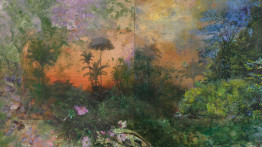
View of Nature; 2026; Oil on linen; 261.6 x 191.5 x 3.8 cm / 103 x 75 3/8 x 1 1/2 in per panel
Photo: Elisabeth Bernstein
Firelei Báez © 2026 Firelei Báez / Artists Rights Society (ARS), New York
Courtesy the artist and Hauser & Wirth
“With mythology, we are constantly telling stories of people and beings, and those stories are one way of expanding our imagination,” says Firelei Báez A’04, an artist whose expansive paintings, immersive installations, and sculptural works challenge conventional understandings of history, identity, and cultural memory. “They're almost like a way of navigating reality differently or expanding the limits of our reality.”
Raised in the Dominican Republic and then Miami, Báez draws deeply from Caribbean histories, folklore, and the layered experiences of diaspora communities. Her work reimagines archival materials such as maps and historic documents, colonial narratives, and mythological traditions to create new possibilities for understanding the past and envisioning more equitable futures.
Encouraged to apply to The Cooper Union by printmaking professor Day Gleason, she credits the printmaking department with influencing her professional practice. The layering, repetition, and accumulation characteristics of printmaking continue to inform her paintings and installations, which frequently unfold as complex visual palimpsests.
Her fascination with archival documents began at Cooper where she found a rich source of inspiration in books deaccessioned from the library. These materials engaged her not only for the information they contained but also for their physical histories—the fingerprints, foxing, creases, and signs of wear left behind by previous readers. For Báez, these traces represent an alternative archive, revealing who interacted with these objects and whose experiences remain absent from official narratives.
Her artistic process merges rigorous research with intuition. The studio functions as what she describes as a “mad laboratory,” where she freely explores ideas, images, and materials before selecting what eventually appears in exhibitions. Her layered compositions often blur the boundaries between painting, printmaking, and sculpture, creating works that challenge viewers’ perceptions of space and dimension. Many of her paintings are scaled to the size of the human body, encouraging an intimate, physical encounter with the work. She says, “Now, I make these large sculptural works that are, for me, more like a permeable painting. So, it looks like an architectural ruin, but it's more like extending space into painting into space.”
Mythology plays a vital role in Báez’s work. She views myths not as escapist fantasies but as tools for expanding collective imagination. In discussing a recent large-scale commission for an international airport terminal, Báez drew inspiration from the myth of Drexciya, a pair of Detroit musicians in the 1990s who imagined a Black Atlantis of the same name. The story reinterprets the horrors of the transatlantic slave trade by envisioning a thriving underwater civilization descended from enslaved pregnant women thrown overboard during the Middle Passage. For Báez, such counter-mythologies offer powerful alternatives to dominant historical narratives and reveal the transformative potential of imagination.
Báez remains attentive to the ways contemporary technologies shape visual culture. While she recognizes the creative possibilities of artificial intelligence, she warns that current systems often reproduce narrow aesthetic norms determined by their creators. As a result, she increasingly generates her own source materials, emphasizing observation, experimentation, and direct engagement with the physical world.
Ultimately, Báez’s work invites viewers to reconsider what lies beyond the boundaries of accepted knowledge. By weaving together history, mythology, material memory, and speculative imagination, she creates spaces where overlooked stories can emerge and where new futures become possible. Through her art, Báez argues that the limits of our world are often determined not by reality itself, but by the limits of what we are willing to imagine.
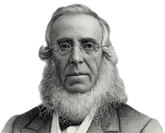
“That's why we love Peter Cooper because he had that belief in a world that was increasingly industrialized and sparse. So we have even more possibility. Our demise is only self-inflicted. So is our abundance.”