Sylvia Plimack Mangold A’59
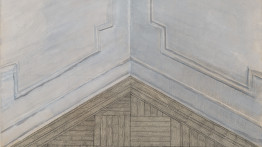
Sylvia Plimack Mangold
Untitled, 1965
Gouache and pencil on paper 16 7/8 x 16 7/8 in. (42.86 x 42.86 cm)
19 3/4 x 19 3/4 x 1 1/8 in., 50.16 x 50.16 x 2.86 cm (framed)
© Sylvia Plimack Mangold. Courtesy of the Artist and Pace Gallery
Sylvia Plimack Mangold has made the objects of daily life—wooden floors, laundry, rulers, mirrors, trees— the subjects of her paintings and prints. While her work is grounded in figuration, she is most interested in exploring the ways we look at things and how our perceptions are influenced by angle, reflection, and framing. Take her “Painted Graph Paper,” a painting she made in 1975 that on first view looks to be a piece of graph paper taped to paper, the masking tape torn unevenly at its edges. At closer inspection, a viewer suddenly realizes that there is no graph paper or tape, that the whole ensemble is a painting. A lot of Plimack Mangold’s art provokes such startling moments, ones that call attention to how we look at our surroundings and all the factors that structure our perception.
Raised in the planned community of Sunnyside Gardens in Queens, Plimack Mangold attended the High School of Music and Art before going to Cooper. She struggled through an architecture class, but the experience influenced her life as a painter: “I would say my early paintings of floors was me getting back to this problem with architecture. It was also a grid that I could use to measure three-dimensional space and strengthen my confidence.” She went on to study painting at Yale, graduating in 1961. Initially, she considered views within her apartment, most famously studying the grain of parquet floors, and made those the medium of her study of perception. Those paintings, she said, are “not about fooling the eye, but about questioning the nature of painting and, thereby, levels of reality.”
While much of her work shows interiors—the focus of the Karma Gallery show—she’s frequently painted the trees near her home in Washingtonville, NY, showing the trees at different points of the year as reflections on time. They are meditative, fine-grained depictions, that, like her paintings of home and studio objects, demand the viewer to look carefully at the tree being depicted while underscoring the illusion of painting itself. By the 1990s, she focused on two specific trees, a pin oak and a maple tree next to her home and studio.
Critics have likened her paintings to those of Edward Hopper and Giorgio Morandi in their ability to evoke solitude and quiet focus. Her work, which has been the subject of many museum and gallery shows, has also been noted for their observations of subtle environmental changes through the seasons. Her process is a deliberate one with a single painting taking over a year to complete. Major museum surveys of her work include The Paintings of Sylvia Plimack Mangold, Albright-Knox Art Gallery, Buffalo, New York (1994), which traveled to Wadsworth Atheneum Museum of Art, Hartford, Connecticut (1995); Blaffer Art Museum, University of Houston, Texas (1995); and Museum of Fine Arts, Boston (1995–96); and many others. Her work is part of worldwide collections including The Art Institute of Chicago; The Brooklyn Museum, New York; Dallas Museum of Art, Texas; Kunstmuseum Winterthur, Switzerland; and The Metropolitan Museum of Art, New York.